LumaSync
releasev1.5.5-rc.6Mirror your screen to WS2812B LED strips and Philips Hue entertainment areas in real time. Local-only, brand-agnostic, MIT-licensed.
README Snapshot
LumaSync




Website: lumasync.app
LumaSync is a native desktop app that mirrors your screen to WS2812B LED strips and Philips Hue entertainment areas in real time. A single calibrated room map drives per-edge LED layouts and Hue channel placement; all processing stays on your machine — no cloud, no telemetry.
It combines a React + TypeScript frontend with a Rust/Tauri runtime to keep the UI responsive while handling native desktop behavior.
Screenshots
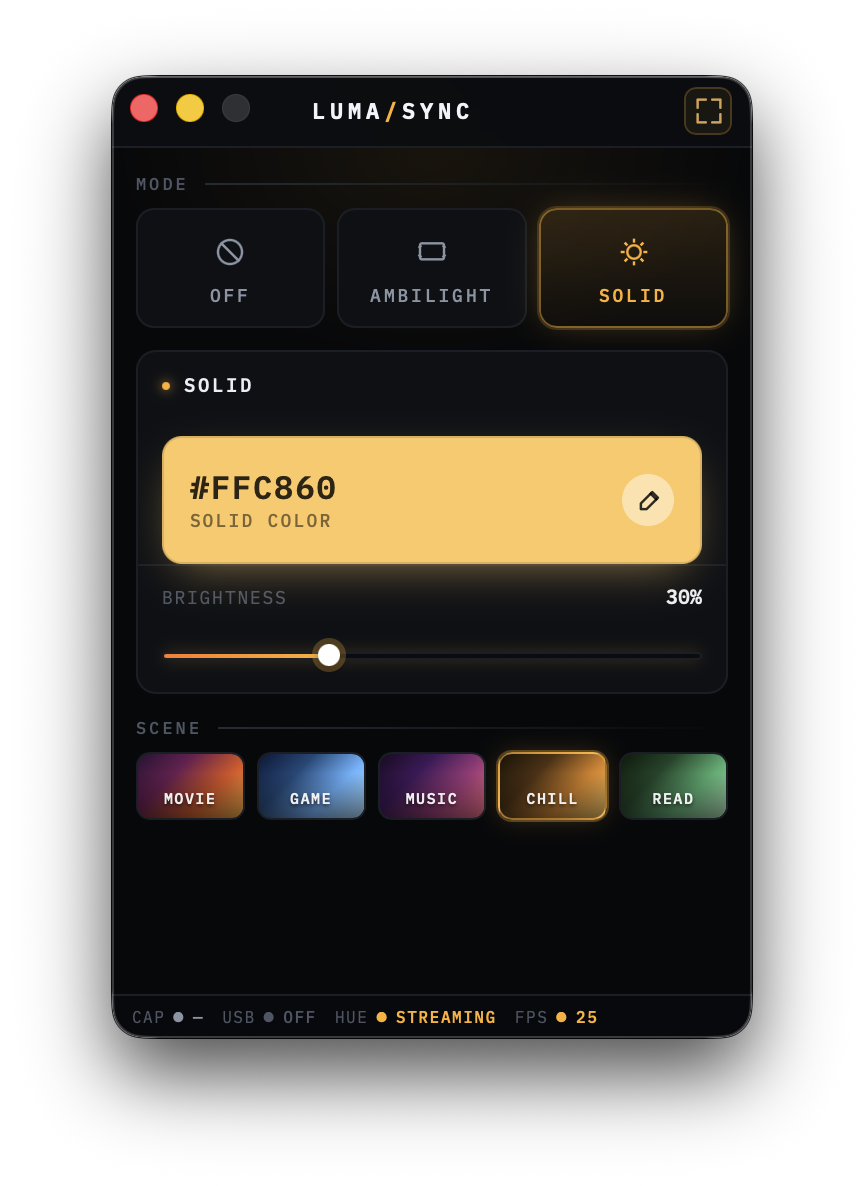
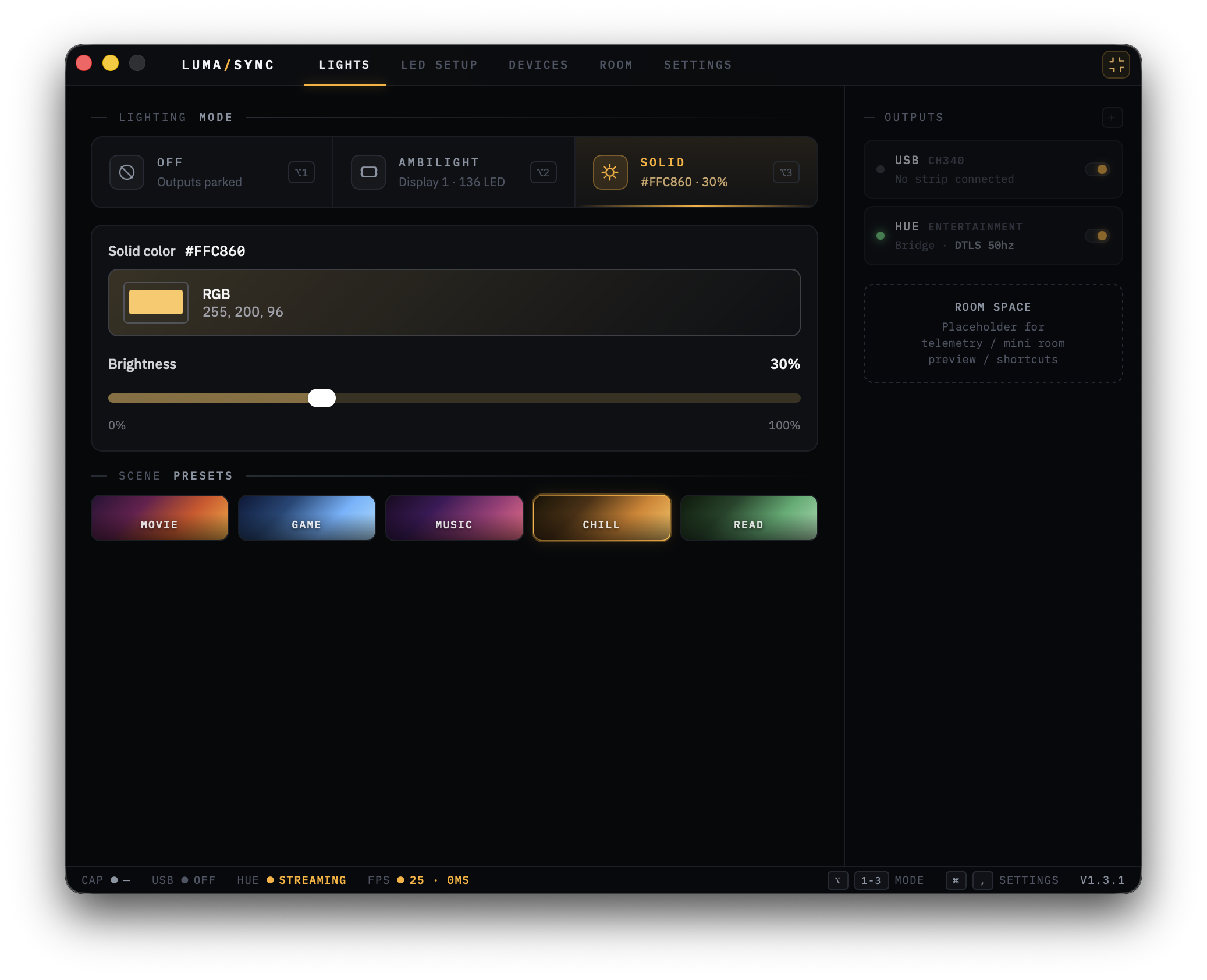
Compact tray-sized mode (320×480) and full workspace mode (900×620) — amber Rev 07 design language, same state shared across both layouts.
Features
- Ambilight: real-time screen capture drives LED strips and/or Hue lights simultaneously, with per-LED edge sampling anchored to the room map
- Philips Hue: DTLS 1.2 PSK entertainment streaming, channel position editor, zone auto-derivation from room map
- Room map editor: drag-and-drop canvas with furniture, TV anchor, and USB strip objects; Hue channels overlaid on normalized coordinates
- Multi-monitor capture: pick which display feeds the lights; hot-plug and resolution changes are handled without restart
- Color correction: per-channel R/G/B gamma, Kelvin white-balance, and saturation trim — tuned once per strip, persisted per layout
- Solid color: RGB + brightness push to USB and Hue with debounced 50 ms update
- LED calibration: edge counts, gap, corner ownership, start anchor, direction — persisted per layout
- Firmware profiles: LumaSync-native framing out of the box; Adalight profile for off-the-shelf microcontrollers
- Target-aware pipeline: choose USB, Hue, or both per mode; hot-plug detection with suggestion banner
- Compact, stays out of your way: lives in the tray; opens as a 320×480 panel for quick scene changes or a 900×620 full view for calibration, on demand
- Runtime HUD: StatusBar pill surfaces live FPS and end-to-end latency with green/amber/red thresholds
- Native notifications: OS-level toast for connection, stream, and update events; permission banner asks once and never re-prompts
- Resilient shell: global error boundary catches render faults and offers a localized restart/logs card instead of a white-screened tray window
- Auto-updater: GitHub Releases with minisign signature verification
Tech Stack
- Frontend: Vite, React 19, TypeScript (strict), Tailwind CSS
- Desktop runtime: Tauri v2, Rust
- Testing: Vitest + Testing Library, Cargo test
- Package manager: Bun
Supported Hardware
USB Controllers
Microcontrollers using the following USB-to-serial chips are supported:
| Chip | USB ID |
|---|---|
| CH340 (WCH) | 1A86:7523 |
| CH341 (WCH) | 1A86:5523 |
| FTDI FT232R | 0403:6001 |
| FTDI FT232H | 0403:6014 |
| CP2102 (Silicon Labs) | 10C4:EA60 |
| CP2104 (Silicon Labs) | 10C4:EA70 |
| PL2303 (Prolific) | 067B:2303 |
| Arduino Uno R3 | 2341:0043 |
| Arduino Uno (original) | 2341:0001 |
Baud rate: 115200. LumaSync ships with two firmware profiles:
- LumaSync-native (default):
0xAA 0x55header, LE LED count, gamma-corrected RGB triplets, XOR checksum. A matching firmware sketch ships with the companion hardware repo. - Adalight: the widely-used
"Ada"header format, compatible with off-the-shelf WS2812B controllers and existing Adalight firmware builds.
Profile is selected per device in the Devices section.
Philips Hue
- Hue Bridge (gen 2+) on the local network
- At least one configured Entertainment Area in the Hue app
- macOS only:
macos-private-apiis required for fullscreen calibration overlays — the app requests this automatically
Platform Support
| Platform | Status | Notes |
|---|---|---|
| macOS | Full support | Primary development target. macos-private-api enabled for fullscreen overlays. |
| Windows | Full support | USB and Hue features work. Windows Graphics Capture powers the capture pipeline. |
| Linux | Full support (v1.5+) | X11 capture via xcap. Requires GTK 3, WebKitGTK 4.1, libudev, and libgbm. |
Getting Started
Prerequisites
- Bun 1.4+
- Node.js 22+ (vitest, wdio and the Tauri CLI still run under Node)
- Rust toolchain (stable)
- Tauri platform prerequisites for your OS
Install
bun install
Development
bun run tauri dev
Build
bun run tauri build
Common Scripts
bun run dev: run web-only Vite dev serverbun run tauri dev: run desktop app in development modebun run typecheck: run TypeScript type checks (no emit)bun run lint: alias for typecheckbun run test: run frontend unit tests oncebunx vitest: run frontend tests in watch modebun run verify:shell-contracts: validate Rust command handlers match frontend contract definitionsbun run check:rust: run Rustcargo checkbun run check:all: run JS + Rust + shell contract checks together
Project Structure
src/: React application and feature modulessrc/shared/contracts/: cross-layer contract definitionssrc-tauri/src/commands/: Rust Tauri command handlersdocs/: debugging, manual, and architecture notes (docs/architecture/README.md)
Documentation
- Debugging guide:
docs/debugging.md - Contributing guide:
CONTRIBUTING.md - Code of Conduct:
CODE_OF_CONDUCT.md - Security policy:
SECURITY.md - Support guide:
SUPPORT.md - Changelog:
CHANGELOG.md
Contributing
Contributions are welcome. Please read CONTRIBUTING.md before opening a pull request.
Security
If you discover a security issue, please follow the process in SECURITY.md.
License
MIT © 2026 voyvodka
Changelog
Changelog
All notable changes to this project will be documented in this file.
The format is based on Keep a Changelog: https://keepachangelog.com/en/1.1.0/
[Unreleased]
Added
- Room map: the TV has an optional mount height. Left empty it follows 40% of the room height, so changing the ceiling moves it too. The TV's footprint field is now labelled Depth, since it never meant the screen's height. A small "Room-aware" chip in the room map toolbar and under the Hue output on the Lights page shows when Hue lights are sampled by where they stand around the TV, and opens a short explanation.
- USB strips: a color order setting for strips whose colors come out swapped, such as red showing as green on many WS2811 strips. Devices → USB Strips has an Identify step that lights the strip one color at a time and asks what you see, then saves the right order and lets you undo it if the colors still look wrong. The order can also be picked by hand. WLED devices set their color order in WLED itself, so the setting is hidden for them.
Changed
- Notices: every message the app shows about its state now appears in one place, one at a time, with a "+N" that opens the rest. In the compact window it sits at the top, above the mode buttons, and pushes them down instead of covering them; the first-run hint and the "no reachable output" message no longer take half the window between them, and no longer say the same thing twice. The full window shows them the same way, at the top of the page. Errors come first, then warnings, then hints. A notice that reports something that happened can be closed and stays up while the pointer or keyboard focus is on it; one that describes something still true stays until it is no longer true. Screen readers hear each new notice once, and no longer hear the frame rate every second.
- Notices now offer a button where there is somewhere useful to go: Hue re-pairing or an unreachable bridge opens the Hue page in Devices, a missing display opens LED Setup, and a Hue output that would not stop can be stopped again. The compact window now explains why the modes are unavailable when the strip still needs calibrating, with a button to LED Setup. The first-run hint no longer asks Hue-only setups to calibrate a strip, and no longer offers "Open lights" in the compact window, where it did nothing.
- Lights: in the full window, "no reachable output", "checking outputs" and "calibration required" now appear as notices at the top of the page, in the same style as every other notice, instead of as separate banners on the Lights page next to a second copy of the same message. Their buttons stay: Open devices, Check again with Open devices beside it once the Hue bridge has stopped answering (the compact window now has both too, the second behind the notice's expand button), and Open setup for calibration. The first-run "calibrate your strip" hint no longer repeats "calibration required".
- Lights: the Ambilight card no longer shows the live preview, which was a capture latency and frame-rate readout, a box standing for the screen, and a colour estimate along each edge. The status bar already shows capture and output health. The card is now called "Mode settings" and keeps its controls: lighting responsiveness, brightness, saturation and black border. The USB link-limit note still appears there when a strip is too long for the serial link.
- Ambilight does less work per frame. It used to sample the screen edges and send them to the app window about ten times a second for the Lights preview removed above, whether or not anything showed them. That stopped. The LED preview overlay still gets its per-LED feed, and only while it is open.
- Devices → Hue Bridges: a bridge that no longer accepts the app's key shows one Re-pair button
instead of two. Error codes such as
AUTH_INVALID_RE_PAIR_REQUIREDno longer fill a stat box in large red text; every bridge card state now shows the code as a small line under its message, where it can still be read for support. A stat box left on its own now spans the card's full width instead of leaving an empty half, on WLED device cards too. - Devices: a Hue bridge whose area needs checking again, or whose start is blocked by an unready setup, shows one Validate button instead of two, and an unreachable bridge no longer shows Rediscover both at the top of the page and on its card. Action buttons on Hue, USB and WLED device cards are now at least 32 px tall and show the amber focus ring when reached with the keyboard.
Fixed
- Quitting with Cmd+Q now finishes cleaning up before the app exits: the Hue lights are handed back and the LED strip is released, as the tray's Quit already did. Before, the app closed partway through, which could leave the Hue bridge in entertainment mode.
- After installing an update on macOS or Linux the app now restarts itself. The update prompt used to stay on "Installing" and the new version only ran after a manual restart. On Windows the installer now waits for the lights to be released before it takes over. The download bar also updates about ten times a second instead of on every chunk, which kept the window busy.
- Changing or stopping the lighting mode, and starting or stopping an LED test, no longer freeze the window for up to a few seconds while capture or the strip starts. Commands sent in quick succession, such as a brightness drag, still apply in the order they were sent. Listing USB ports, connecting a WLED device and moving Hue credentials into the keychain no longer freeze it either.
- Starting at login no longer opens the window over whatever you are doing: LumaSync starts in the tray. On macOS, clicking the Dock icon now opens the window.
- A crash inside the app is now written to the log file with where it happened, including on Windows, where it used to leave no trace. On macOS 15 the local network permission prompt now says why LumaSync needs it: to find and control your Hue bridge and WLED devices.
- The "Screen recording permission is required" notice no longer disappears after eight seconds while the permission is still missing, taking its System Settings button with it. It now stays until the permission is granted or lighting starts, and the app notices the change on its own when you come back from System Settings.
- Notices no longer appear on top of the update prompt, where they could be clicked but not reached with the keyboard. They wait underneath it, and anything that arrived meanwhile is shown once the prompt closes. The update prompt now fits the compact window: its text scrolls and the Install and Later buttons stay visible.
- The close button on the first-run hint and the reconnect button in the compact status bar are now large enough to hit reliably. The Turkish "USB device not recognised" notice no longer says "Hue-only" in English.
- Unplugging the LED strip while it was the only output now turns lighting off and says the strip was disconnected. Before, nothing was said, the mode still looked like it was running, and screen capture carried on for a strip that was gone. This includes a launch that was running on the strip alone while it waited for a busy Hue bridge: the wait for Hue ends too, so the notice no longer claims lighting is "running on USB only". Your saved outputs are not changed, so the strip is used again once it is back.
- The HUE entry in the status bar no longer reads OK while Hue is left out of the running lighting. It shows WAITING while the app waits for a busy bridge to let go, and LEFT OUT when Hue could not join, and keeps saying so after the notice has gone, until Hue joins or you change the mode or outputs. The status bar values are now translated, so they appear in Turkish too.
- The "USB device not recognised" notice no longer says the app switched to Hue when no Hue bridge is paired. It now says no other output is set up.
- Opening the LED preview from the tray or from LED Setup no longer lights your Hue lamps. The test pattern that starts by itself when the popup opens now goes to the LED strip (USB or WLED) only. With no strip connected it shows in the overlay only, and the popup says so. Hue lights join the test when you pick a pattern in the popup, as before.
- Lights and the compact window no longer say "No reachable output" and ask you to pair a Hue bridge while an already paired bridge is still being checked, which happened for a second or so after opening the window. They now show "Checking outputs…" until the bridge answers; Ambilight and Solid stay unavailable until then, and the no-output message appears only if it does not. The same message could also flash at launch before the app had read which bridge you paired, and the Hue output on the Lights page briefly read as not paired; both now say they are checking until launch has finished.
- The USB health check now describes each step in the app's language. It used to show the backend's English text for every step, even with the app set to Turkish. Raw diagnostics such as an adapter's VID/PID or an operating-system error still appear as they are, and a stopped check now says so instead of naming an internal worker.
- Hue pairing no longer says your credentials have expired when the bridge is busy or has had too many pairing attempts. It now asks you to wait and try again. A bridge that rejects the pairing request says so, and no longer shows the generic sign-in error.
- Opening the LED preview from the tray or from LED Setup now tells you when the control popup or the twin overlay could not open, for example because the chosen display is gone. Before, the click did nothing and said nothing. From the tray, the notice waits for the main window to be shown before it disappears.
- Devices → Hue Bridges could show the bridge as Ready while it was streaming, when lighting started with that page already open — from the tray, a keyboard shortcut or the session restored at launch. The card now switches to Streaming as soon as the stream starts, and after its own Stop button it no longer keeps showing Streaming for up to ten seconds.
- Devices → Hue Bridges no longer shows the bridge as Ready when the app briefly fails to read the stream's state. A single failed read during a stream used to switch the card to Ready and stop it checking again, so it stayed wrong until you started or stopped lighting. The card now says the status is being checked, keeps retrying on its own at a slowing pace, and returns to Streaming or Ready as soon as a read succeeds.
- Devices → Hue Bridges no longer shows the bridge as Ready after the Hue stream has stopped for good — when reconnecting gave up, a start was cut short, or the bridge refused the app's key. A stream that had run out of retries also no longer claims to be reconnecting. The card now says the stream stopped and why, and offers Start Again, plus Re-pair when the key was the problem. The status bar and the Hue output on the Lights page say the same instead of OK and standby.
- Switching between the compact and full window could stop working after the window had been hidden, covered or left behind a locked screen: the switch made in that state never finished, the window content stayed blank, and later switches from the title bar, the settings shortcut or the tray did nothing until the window was shown again. The switch now always completes.
- USB: a failed connection no longer leaves the port behind as if it were the connected one. After a port was refused, for example an unplugged strip or a port that is not a supported USB adapter, the room map could show a strip on that port as online. Starting a lighting mode would also try to send colors to the refused port. Now nothing counts as connected until a port has actually bee
Releases
- LumaSync v1.5.5-rc.6Open on GitHub
Fixed
- WLED boards can be found, connected and tested again. The app sent each of these requests in a shape the other side of the app did not accept, so every one was turned away before it did anything: Discover showed an error straight away, Connect and Test never reached the board, and a WLED board saved from an earlier session was not re-connected at launch. The requests now use the shape the app expects, and a test drives all three through the real request path so the two sides cannot drift apart silently again.
- Pairing a Hue bridge now finishes when you press the button on the bridge. The app asked the bridge once, and when the button had not been pressed yet it showed a "press the button, then wait a moment" card that never asked again, so the press opened the bridge's 30-second pairing window with nothing listening (#337). The app now keeps asking every two seconds for a minute and pairs as soon as the press registers, with no extra click. If the minute runs out the card says so and offers Try again. "+ Pair" on a discovered bridge starts pairing straight away instead of opening a card about repairing credentials, and cancelling no longer leaves the bridge stuck on the old pairing card when you pick it again.
- Saving Hue light positions to the bridge no longer moves the wrong light. Each position was addressed by the light's place in the list rather than by the number the bridge itself gave it, and those two only agree while the numbering has no gaps — which it stops having as soon as a light is removed from an entertainment area. Positions are now sent under the bridge's own number. A light the app has not yet matched to the bridge is skipped and reported instead of being written under a guess, and the lights beside it still save.
- The Hue channel panel no longer vanishes, or says the same thing, whenever it has no lights to show. An area with no lights, a bridge that never answered, and a reply the app could not read all produced the same empty result — usually no panel at all — so a dropped bridge was indistinguishable from an area you had emptied on purpose. Each now says which it is, and when the bridge stops answering the last known lights stay listed and marked as such, with the save-to-bridge button held back until it answers again.
- A Hue bridge that stops answering no longer empties the channel list. A brief network drop looked exactly like an area that had been deleted: the lights vanished from the panel, and only a reconnect brought them back. Not being able to reach the bridge is now told apart from the bridge saying there is nothing there, and the last known lights stay on screen. Nothing saved is removed either way.
- A Hue zone dragged against a wall now shows which wall stopped it. A zone cannot leave the room, so its handle stops as soon as the box edge reaches a wall — but the handle sits at the centre, which on a large zone is metres away from that edge, so the drag looked stuck for no visible reason. The edge that is holding it now lights up while you drag.
- The room map opens framed on your actual room again. It was always sized as though the room were the 5 × 4 m default, because the view was fitted before the saved room had finished loading — so any larger room opened too far zoomed in, running off the edge of the canvas instead of sitting centred in it. Zooming or panning afterwards still behaves as before, and resizing the room still leaves your view where you put it.
- Two Hue entertainment areas no longer overwrite each other's light positions. Positions were stored under the light's number alone, and that number restarts at zero in every area — so the second area's first light and the first area's first light were the same record, and whichever you arranged last replaced the other. Each position now records the area it belongs to; existing arrangements are assigned to the area you last worked in, which is the only one that could have written them. The room map shows one area at a time, since selecting a light there still identifies it by number alone.
- Locking a Hue light no longer comes undone when you put it in a zone. The lock was not part of what the zone editor sent back, so it was dropped on the way through.
- Moving a Hue light on the Devices channel map no longer undoes the room map. Every save there rebuilt each light from scratch, so its name, its lock, and the zone the room map had put it in were quietly thrown away — and because the rebuilt record no longer said which entertainment area it belonged to, a second area's lights overwrote the first's. Moving a light that belongs to a zone now moves it within that zone, which is the position the lights actually follow, instead of writing one nothing reads. Saving also no longer deletes the lights the panel cannot see: it only ever shows one bridge's lights, so everything else — another area, or all of them while the bridge is unreachable — was being dropped.
- Resizing the window by dragging its edge is now remembered. Only the size the window had when you last switched between the compact and wide layouts was ever saved, so any resize you made afterwards was lost on the next launch and the window went back to that older size. The compact layout keeps its fixed size, as before.
- The wide window no longer opens taller than the screen. Its size was applied without ever checking the display it was about to land on, so on a short screen — or one with a tall taskbar — the bottom edge sat off-screen, taking the resize grip with it and leaving no way to drag it back. A size remembered from a larger monitor had the same effect after moving to a smaller one. The window is now shrunk to what the screen can hold, taskbars and docks excluded, and the smallest size it will allow comes down with it. It is only ever shrunk: a window smaller than your screen stays the size you chose.
- The signal readout no longer reports zeros in a Hue-only session. It always showed the USB numbers, and a session with no USB strip still carries a USB record — full of zeros — so "0ms" and "0 fps" sat under a Signal heading while the Hue bridge streamed perfectly, which reads as a dead pipeline. The heading now names the output being measured, and for Hue it shows the bridge's packet rate. Hue reports no latency figure at all, so that half reads "—" rather than inventing one.
- Searching for a WLED board, or testing one, no longer freezes the window. Both ran on the thread that draws the interface, so a board at an address nothing answers on locked the whole app until the probe gave up — two seconds for a search, and longer for a test, which makes two round trips with a pause between them. Both now run off to the side, and the interface stays live while they work.
- Adding a Hue light to the room map no longer produces two entries that behave as one. The new light was numbered by counting how many were already placed, which on a map with a gap in its numbering — every map written before v1.4.0 — hands it a number another light already has. From then on the two are indistinguishable: moving, locking or renaming either one changes both, and since nothing ever removes a light from the map, it could not be undone. New lights are now numbered past the highest in use.
- The first-run guidance banner no longer pushes the bottom of the window off-screen. It sat above the layout rather than beside it, so the layout kept its full height and slid down by however tall the banner was — and that strip was cut off, not scrollable, so nothing could bring it back. In the compact window the banner also grew to roughly half the height available, which took the entire scene row with it. The banner now shares the space instead of displacing it, and in the compact window its button moves to its own line so the text has room.
- The log file no longer records every line twice, and no longer leaves a second, differently-cased copy of itself beside the first. The logger was given its two outputs on top of the two it already had by default, so each line went to the terminal twice and, in a release build, to the same file through two handles — which also made the file look twice as busy as the app was.
- On Windows, the preview and calibration overlays no longer open blank and leave the app unreachable. To let clicks through, the overlay marked every window the browser engine had created inside it — but one of the two flags it used tells Windows the window must not be drawn until the program supplies it with a transparency setting, which is not something we can do for a window the browser engine owns. So the overlay covered the screen showing nothing, and since it carries no title bar and stays out of the taskbar there was little left to close it with. That flag is gone; letting clicks through never depended on it, and the overlay window itself already passes them to whatever is behind it. Two smaller faults on the same path went with it: the overlay asked for a fully transparent background, which Windows reads as solid black and paints over the whole screen, and the overlay was created while the app held a lock the browser engine could re-enter during creation — enough on its own to freeze the app before anything appeared. The overlay also no longer takes keyboard focus when it opens. Reproduced and confirmed on a Windows machine in the build pipeline — the old marking turns the whole display solid black, the new one draws the overlay over the desktop and lets clicks through — and that check now runs on every change.
- A failed update check no longer reads as a failed installation, and stops showing you a URL as the explanation. When the app could not reach the update server it announced "installation could not complete" — over an installation that was never attempted — and put the raw message from the update plugin, which contains the address of the release feed, where the explanation should be. It now says the server could not be reached, notes that nothing has changed, and keeps the raw message as a technical detail underneath. A genuine installation failure is unchanged.
- Status messages in Devices and the WLED picker use the same colours as the rest of the app. Four of them had been written against a raw palette that bypassed the theme, so a success or a failure looked subtly different depending on which panel it appeared in — and none of them had a high-contrast fallback, which left them unreadable in forced-colours mode.
- LED Setup no longer explains a problem in the app's own error codes. A layout it refused to accept was reported as, literally, "NO_LEDS_CONFIGURED: counts" — the same in Turkish, since it was never a sentence to begin with. All six refusals now say what is wrong in the language you are using, and the strip that carries them is announced rather than silently appearing.
- The LED Setup header stops breaking mid-phrase in a narrow window. The LED count, length and power sat in a group that absorbed the entire squeeze while the buttons beside it kept their width, so the text was the only thing that gave — worse in Turkish, whose labels run longer. The header now wraps as a whole, and the length-and-power figure stays on one line.
- Opening the LED preview now gets the main window out of the way, and closing the preview brings it back. The preview covers the screen it is testing, so the window it was launched from was sitting behind it for no reason. Opening the preview from the tray, with the window already away, leaves it that way — closing the preview only restores a window the preview itself hid.
- Locking a room-map object now also stops the keyboard moving it. The lock held against the mouse but not against the arrow keys or the rotate shortcut, so a pinned TV or strip could still be nudged out of place by a keypress — deleting was the only action that had ever checked.
- Nudging a Hue light that belongs to a zone moves it, and the position readout tells the truth. A light in a zone is positioned relative to that zone, and that is what the map draws — but the arrow keys and the coordinate boxes were reading and writing an older, separate pair of numbers the map ignores. So arrow keys appeared to do nothing at all, and the numbers on screen described somewhere the dot was not. Both now work in the same coordinates the map draws from.
- The room map has zoom buttons and a fit-to-view control. Zooming needed a scroll wheel or trackpad and fitting the room to the window needed a keyboard shortcut nothing mentioned, which left both out of reach for anyone working from the keyboard or a plain mouse. The control sits in the corner of the canvas and shows the current zoom.
- Right-clicking a Hue light no longer offers a Delete that does nothing. Hue lights come from the bridge and LumaSync cannot remove one, which the sidebar already knew — it hides the delete button there. The menu offered it anyway and the click was silently ignored.
- The window can be moved and closed while a dialog is open, and the dialogs themselves can be used from the keyboard. Both dialogs dimmed the entire window including the title bar — which is the drag surface and holds the window controls — so anything behind them became unreachable until the dialog was answered. The dimming now stops below the bar. Separately, opening a dialog moves focus into it, Tab stays inside it, Escape closes it, and focus returns to whatever opened it when it goes; the update dialog claimed to assistive technology that the rest of the window was inert while focus could still tab straight past it, and the unsaved-changes dialog announced itself as nothing at all. Escape on the unsaved-changes dialog means keep editing, never discard.
- Dragging the colour of a running test pattern glides instead of stepping. Every commit of the drag rebuilt the whole capture-and-output worker, expensive enough that the interface had to hold the update rate down to four a second — so a slow drag arrived as a handful of jumps. The pattern and its speed now live somewhere the running worker can see, so changing either reaches the lights without rebuilding anything, and the update rate has been raised to match. Changes that genuinely alter the shape of the output, such as editing the LED layout or switching monitor, still rebuild.
- A room-map Hue zone that the app refuses to accept no longer saves anyway. Every zone edit was sent to be checked, but nothing ever read the answer — the checks reported a refusal by returning it rather than by failing, and the editor was only watching for a failure. So a zone that reached past a wall, a channel moved into an area it does not belong to, or an eleventh light added to a zone that holds ten were all written to disk exactly as if they had been accepted, with nothing on screen. Refused edits are now undone and explained, and the size control stops at what the zone's position actually allows instead of at the room's width — which is what let a zone sitting against a wall be grown past it in the first place. The per-zone light limit was never enforced at all: the editor sent the change as already made, so the check compared it against itself and always passed.
- The chase test pattern is a comet again rather than a single lit LED. Its tail was specified as a physical 4 cm at an assumed 60 LEDs per metre — which works out to the same 2.4 LEDs on every strip between roughly 16 and 400, so what travelled the room was one bright LED, one at just over half brightness and one too dim to see. The tail is now at least five LEDs and grows with longer strips, capped so it never spans enough of the room to stop reading as a moving head. The rule that the tail must always cover at least one frame's travel is unchanged; it is what stops the comet skipping LEDs at speed.
- An LED test started with the lights off now lights a Hue bridge instead of reporting that nothing is connected. A test pattern turns output on — that is what it is for — and it always did so for a USB strip, because a strip stays connected whether or not a lighting mode is running. Hue was checked differently: the app asked whether a stream was open at that moment, which with the lights off it never is, so a paired and perfectly reachable bridge read as absent and the test fell back to showing the pattern on screen only. The test now opens the stream itself and closes it again afterwards, leaving a stream that was already running — because a mode is on, or the preview window is driving it — alone. LED Setup's test also stopped assuming USB: it now tests whichever outputs were last lit, so a Hue-only setup can finally use it.
- Switching device category in Devices starts you at the top of the new one. All the categories share a single scrolling panel, so scrolling down a long strip list and then clicking another category opened it mid-page, past its own heading.
- A Hue stream that fails to release the bridge on the way down is now retried instead of abandoned. Releasing the entertainment area is done by whichever part of the shutdown gets there first, and the others stand down so the bridge is not sent the same instruction three times — but that hand-off happened before the request, so if the request then failed, everyone else had already stood down. The bridge kept the area reserved and the next attempt to stream reported that something else was already using it, usually until the bridge was restarted. A failed release now puts the job back so the next part of the shutdown picks it up, and the failure is written to the log either way.
- The first frame sent to a USB strip is no longer swallowed by the board rebooting. Connecting a controller waits out the ~2 s reset that opening the port triggers on Arduino-style boards — but it then closes the port, and the first frame reopened it, resetting the board a second time with nothing waiting for it. Turning on Ambilight or a solid colour could start with a stretch of dark or garbled LEDs. The output path now waits the same settle once per connection, and nothing is added to any later frame.
- Switching everything off when one output refuses no longer strands the other. USB and Hue were stopped together, and a failure on either abandoned the whole transition: the output that did stop kept showing as active, and the lighting mode stayed on whatever had just been turned off. Each output's outcome is now recorded on its own, so the one that stopped is reported as stopped, the one that did not stays visibly on, and the mode reaches Off either way.
- Selecting a second Hue entertainment area while the first one streams shows that area's own lights. The runtime kept one cached channel list with no record of which area it belonged to and handed it to any area that asked, so the picker listed the streaming area's lights under the newly selected one — and any per-channel region you then set was saved against the area you thought you were editing, which meant the mistake outlived a restart. Existing overrides are left alone; re-setting a region that looks wrong is enough to correct it.
- "Continue in background" during an update download now does that. Dismissing the dialog only reset the updater to idle, while the download carried on reporting progress — and the first progress report after the click put the dialog straight back, so the button appeared to do nothing. Dismissing now hides what was dismissed and leaves the download alone; the dialog returns when the download finishes, since the app is about to restart, and a newer version found later is never hidden behind an earlier "Later".
- Switching the capture monitor in LED Setup moves the lights to that monitor. The choice was saved for next launch but never reached the running session, so Ambilight kept mirroring the old screen — and the next brightness or mode change re-sent the monitor it had been started with, putting it back even if something else had moved it.
- Changing the LED chip type takes effect without reconnecting the strip. SK6812 RGBW sends four bytes per pixel where WS2812B sends three, and the running encoder kept whichever setting was in place when the app started; the choice only applied on the next connect. Until then the strip was being driven with the wrong wire format, not merely the wrong colours.
- Pairing a Hue bridge takes effect straight away. Nothing told the rest of the app a pairing had completed, so the bridge stayed unknown to the reachability check and to the output banner until the next lighting-mode change — a freshly paired bridge could sit behind "no reachable output" while working perfectly. Choosing a different entertainment area had the same delay.
- "Check again" for an unreachable Hue bridge now shows that it is checking, and stays put. Pressing it re-armed the probe, which immediately cleared the gave-up state the button itself depended on — so the button vanished under the cursor and the only sign anything had happened disappeared with it. It now reads "Checking…" while the probe runs, and remains on screen if the bridge is still absent, rather than silently returning to a minute and a half of background polling.
- Clicking a control twice before it finishes now settles on what you asked for last. Three surfaces started work the user could re-trigger while it was still running, and each one let whichever request happened to finish last win: choosing a second monitor while the first switch was in flight discarded the new choice entirely and left the overlay, the picker and the saved setting on three different answers; turning an output off while turning another on could put the first one back; and a manual update check racing the one at startup could show the older answer. The monitor buttons also stay disabled while a switch is in progress.
- Two settings saved at the same moment no longer undo each other. All persisted shell state — window geometry, last section, lighting mode, the bound device, the room map and its grid settings — lives in one file that every writer read, modified and wrote back. Two writers overlapping meant the second read a snapshot taken before the first had landed, so it wrote back the older value and silently reverted whatever the first had just changed. Writes are now serialised, and a write that fails no longer blocks the ones queued behind it.
- Device cards use the width they are given, and their buttons stop spilling out of the card. The Devices panel laid every category out in two fixed columns at any window size, so a single paired bridge left a dead half beside it, and a narrower window squeezed both cards until the action buttons pushed past the card edge — measured at 560 px and below, and worse in Turkish, whose labels run several characters longer than the English ones. Cards now reflow to the space available, and a row of buttons wraps rather than overflowing.
- LumaSync stops looking for a Hue bridge that is not answering, and says so. On a different Wi-Fi network from the paired bridge, the app kept probing it silently for the whole session with nothing on screen to explain the permanent "no reachable output" state. It now gives up after a minute and a half of unbroken failure and offers a "check again" button; a brief drop on the right network still recovers on its own, because a single success clears the count.
- That giving-up now actually happens. Switching lighting mode re-derived the paired-bridge details into a new object even when nothing about the bridge had changed, and the probe restarted with a clean slate every time — so on a session with any normal amount of mode switching the failure count never reached its limit and the explanatory banner never appeared. The details are now only replaced when they genuinely differ.
- The wide window no longer offers Ambilight, Solid and the scene tiles when nothing is connected. Picking one started a mode with nowhere to send frames; the compact window had guarded this all along. The wide window now dims those controls, explains that no output is reachable, and offers a shortcut into Devices — while Off stays available, as always.
- The room map opens with the room framed and centred in the canvas. It measured the canvas only on the very first render, which happens while the saved map is still loading and the canvas does not exist yet, so the measurement never arrived and every visit started at default zoom in the top-left corner.
- LED Setup's "Run test pattern" lights the strip. It called a command that checked whether a device was connected and then reported success without building a frame, an encoder, or sending anything, while the editor showed a pulsing "Output active" badge over output that did not exist — and the marker animation meant to walk the strip advanced an index nothing on screen rendered, so neither half of the feature was real. The button now drives the same pattern engine as the LED preview, sizes the pattern from the LED counts currently in the editor rather than the last saved ones, and refuses with a reason when there is no layout to test.
- LED test patterns now run with the output settings the rest of the app uses. They ignored the configured chip type, firmware profile, and colour correction entirely, so an SK6812 RGBW strip was driven through the WS2812B encoder and an Adalight controller through the LumaSync v1 header — the test lit nothing, or the wrong colours, on exactly the hardware it exists to verify.
- Test patterns reach a WLED strip, and stopping one restores the previous mode. On a WLED-only setup the test was reported as preview-only and never lit the strip, and Stop was silently rejected, leaving the pattern running with no way to end it.
- The chase pattern is a comet: a full-brightness head with a trailing fade, holding its speed and size the whole way round. It previously skipped LEDs at the medium and fast speeds, ran nearly three times faster along the long edges than the short ones, and reached the strip at a fraction of the requested brightness.
- Changing a test pattern's colour or speed no longer restarts its animation from the beginning.
- Closing the LED preview no longer switches the lights off when the test is not what is driving them.
- The digital-twin overlay opens on the selected display when launched from LED Setup, and its edge ribbons line up with the LED dots they mirror.
- Stopping the Hue stream from the Devices tab no longer has the app put it straight back. That button reached the stream through a path that left the cached stream status untouched, so the health check running moments later could still read "running" and restore Hue as an active output — undoing the stop the user had just asked for.
- A save failure now raises its warning on the surface that failed. One "could not be saved" flag was shared between the USB strip list and the Hue channel map, so failing to add a strip put a "position not saved" warning inside the Hue panel, and a failed channel move accused the USB strips of not saving — with whichever failed last resetting the other banner's timer.
- Adding a floor plan to the room map says so when it fails. A rejected file picker or a failed copy left the map unchanged with nothing on screen and nothing in the log, so the click simply appeared to do nothing.
- Selecting a Hue channel in the room map shows and locks that channel, not whichever one happens to sit in the matching array slot. On maps saved by v1.4.0 or earlier — where deleting a channel left a gap in the list — the property bar showed a neighbouring channel's coordinates or went blank, and a locked channel could be dragged.
- Pairing a Hue bridge now fills the entertainment-area list on its own. It arrived empty and needed a manual "Refresh areas" click, and re-pairing a bridge asked for the areas with the application key the bridge had just replaced — so a bridge that had rejected the old key answered a successful pairing with "re-pair is required".
- On macOS, LumaSync checks the Screen Recording permission rather than inferring it. Every failure of one system call was being read as a missing permission, so the app could tell someone to grant access they had already granted; meanwhile the display picker needs no permission at all, so a genuinely blocked user saw every screen listed as usual, chose one, and got a mode that lit nothing. One honest limit: the check cannot separate "refused" from "never asked", so the wording asks you to check the setting rather than claiming you denied it.
- A screen capture that fails now reaches the user, whether it fails on the way up or hours into a session. The result of starting Ambilight was discarded outright — the backend reports that kind of failure inside an otherwise successful reply, and nothing on screen was reading it — while a display unplugged mid-stream only incremented a counter in the log. The health figures made it worse by freezing at the last good frame during an outage, so a capture that had stopped working kept reporting a healthy frame rate.
- A lighting mode the backend refuses to start no longer appears switched on. The failure notice and an Ambilight toggle reading ON could sit on screen together, and the mode that never ran was saved as the one to restore — so the next launch opened in a state the app had already failed to reach.
- A WLED strip is remembered and re-bound on the next launch. USB strips have always had a remembered port and automatic recovery; WLED had neither, so a network strip was reconnected by hand every time the app started, and nothing on screen said which device was bound.
- Leaving the address blank when adding a WLED device no longer produces a raw error string. The hint text invited exactly that, and the request went out with no address at all, so the refusal came back as an untranslated internal error.
- An expired Hue application key says so instead of reporting an empty entertainment area. The bridge's refusal was caught and turned into "this area has no channels", which sent people looking at their Hue setup for what was only a re-pair.
- The serial link-saturation figures in Runtime telemetry appear. Both values were dropped in transit between the backend and the panel, so the panel had always shown them blank.
- A WLED strip longer than about 487 LEDs now lights correctly. Every frame was sent as one oversized datagram, which the network then had to split; on Wi-Fi — where most WLED boards live — a lost piece takes the whole frame with it. Frames are now split at a size that crosses the network intact, and only the final piece tells the strip to display, so partial frames no longer flash. This is what makes "use WLED for long strips" true past 487 LEDs, which is where the USB serial path already ends.
- The non-DDP WLED protocol option sent malformed packets and has been replaced. Its frames put the timeout where WLED expects the protocol number, so the device misread every colour and wrote them to the wrong LEDs — the packet matched no protocol WLED defines. It now speaks DRGB, and switches to DNRGB by itself on strips too long for a single packet. Nothing in the interface ever offered the broken option, so this can only have been reached by hand-editing settings; such a setting is migrated on read.
- Testing a WLED bridge no longer reports success it did not verify. The test asked the device for its details over HTTP — which is real, and still cross-checks the LED count — but then sent one UDP frame and called that a round trip. UDP has no acknowledgement, so a wrong realtime port, a rejected format, or a dropped packet all passed. It now checks the port against the device's own setting, and after sending asks the device whether it entered realtime mode: a confirmed result and a "sent, not confirmed" result are now different answers. The timing figure is labelled send latency, because that is all it ever measured.
- Starting a mode whose calibrated strip length disagrees with the WLED device's LED count now says so. WLED lights the first N LEDs of a short frame and truncates a long one, so the strip half-responds — which reads as a wiring fault and sends people to their solder joints. Lighting continues; the mismatch is now reported with both numbers.
Added
- A Hue light's height can be set from the room map, in metres. It was only editable on the Devices page, as a slider reading -1 to 1 with no unit — a number that means nothing on its own and was read out to a screen reader exactly as stored. The room map now shows the height in metres against the ceiling height you configured, and says whether it sits at floor, eye or ceiling level. The sliders in that panel are also easier to hit: the grab handle was smaller than every other control in the app, and it disappeared entirely in high-contrast mode.
- The tray menu has a Close Overlays item. The preview and calibration overlays cover a whole screen, carry no title bar and stay out of the taskbar, so if one ever stops letting clicks through there is nothing left to close it with — and on Windows that has happened. The tray belongs to the desktop and cannot be covered, so this closes every overlay, puts the preview controls away and brings the main window back, without needing the window it is rescuing.
- A beta update channel, switchable in Settings → System. With it on, LumaSync also offers prereleases; with it off nothing changes. Beta is a superset — a stable release still reaches you on the beta channel, so a tester is never stranded on an older prerelease. The description says plainly what CI does and does not prove about a prerelease: it builds and tests them, but never launches the packaged installer itself.
- Each log file now opens with the version, build type and update channel that wrote it. Stable and beta are one installation writing the same file in turn, so nothing in a log said which build produced a line.
Changed
- Frontend and Rust dependencies refreshed to their latest stable releases, including Vitest 4 → 5 for the test runner, React 19.3, and the Tauri plugins kept on matching npm and crate versions.
screencapturekit8.0.1 → 10.0.3 (macOS capture). The frame callback now reads the pixel buffer through the crate's lockableCVPixelBufferaccessor and its checked byte view; downscale, cursor suppression, display selection and the Swift runtime linkage are unchanged.- Ambilight relates the lights to each other and to the scene instead of sampling each one on its own. Neighbouring LEDs used to land on unrelated colours — twenty independent samples down one edge rather than one lit room — and every sink moved at one fixed rate whatever was on screen. Each frame is now analysed once: lights that sit close and read close are drawn together, while a genuine boundary (sky over grass, a split-screen) stays a boundary; every light takes a little of the room's overall colour, and a Hue bulb placed away from the TV wall takes mostly that, with a hint of its side of the screen, instead of a hard sample of the bottom of the frame. The Subtle / Moderate / Intense choice keeps its name and now sets the most the lights may move: a still scene steers gently below it, a hard cut uses all of it. The strip is also sampled twice as densely per LED. Both changes cost well under a tenth of a millisecond per frame.
- LED Setup is drawn in the app's own colours. It was still using the stock palette it was built against, so its greys read lighter, its amber duller, and its preview toggle was a near-white slab in an otherwise dark window. Nothing moves or changes behaviour; the page now matches every other surface.
- The window opens in whichever mode you left it in. Every launch forced compact and threw away the persisted choice, so anyone who preferred the wide layout re-selected it after every restart. The stated reason was a visible big-to-small flash during startup, which is not something that can happen: the window is created hidden and only shown once its size and position have been applied. Wide mode is now restored — at the size you last left it — before the window appears.
- Where you place a Hue light in the room map is now what the app samples from. Until now the lights followed the positions stored on the bridge, so arranging them here changed nothing until you pushed those positions to the bridge and the app read them back — and the coarse buttons on the Devices page never reached the lights at all, on any path. Your placement is sent when the stream starts, so it takes effect the next time lighting comes on. Writing positions to the bridge stays a separate, deliberate action, since that layout is shared with the Hue app and anything else that streams.
- The room map calls each Hue light by the number the bridge gives it, and says how many bulbs it drives. It was numbering them by their place in the list and adding one — so on any area with a gap in its numbering, every name on the map was wrong, and it disagreed with the Devices page besides. A light the app has not matched to the bridge now says so instead of borrowing a number, and one the bridge has stopped reporting explains why it is still on the map.
- The Hue panel in the room map no longer squeezes its own status line into one word per line. The re-read button was placed beside the text without allowing the row to wrap, so in the 280-pixel dock the heading broke after every word and the line under it was cut off mid-word — worse in Turkish, where the label is longer. The button now drops to its own line when it does not fit. In the same panel, the zone's edge and colour fields no longer split a label from the box it names when the row wraps, and on the Devices page a channel's light count is shortened rather than pushed out of its column.
- The Devices page now says whether the bridge holds the same light arrangement you do, and lets you settle it either way. Until now the only clue was your own memory of whether you had pressed save, and closing the app lost even that. It is deliberately not phrased as a fault when the two differ: your lights already follow your arrangement, and what is behind is the copy the Hue app and a Sync Box read. Alongside the existing send there is now a take-the-bridge's, which asks first because it replaces what you have. Both are held back while lighting is running, since the arrangement in play at that moment is yours rather than the bridge's.
- The room map reads your Hue bridge itself, instead of waiting for the Devices page to tell it what exists. Until now the lights only appeared on the map after that page had been opened at least once — so a fresh install could open the room map to an empty room while the bridge was streaming perfectly. A light added to the entertainment area now shows up on the map, a light removed from it is drawn as a dashed outline rather than silently lingering as though it were still there, and a button re-reads the list without restarting the app. A bridge that stops answering leaves the lights exactly as they were.
- An entertainment area you emptied in the Hue app now reads as empty on the room map, instead of as a bridge that stopped answering — and the lights left behind on the map are shown as leftovers rather than as though they were still there. A failed read is told apart from both: it leaves the lights exactly as they were and claims nothing about them. The room map's object list also shows the same area the map itself does; it was listing every area's lights, and because a light is identified by its number alone, picking one there could select a different area's.
- The Devices page no longer offers a second place to position Hue lights. It listed five coarse buttons — left, right, near, far, centre — beside the room map's free placement, which is two surfaces for one job and the smaller of the two could never express what the room map can: distance and height in metres. The page now lists what the bridge reports for the area — each light's number, how many bulbs it drives, and which zone it belongs to — keeps the bridge sync, and links to the room map. Any position you set with those buttons is kept; only the buttons are gone.
- The room map now shows the Hue lights your bridge actually reports, and its Add Hue Channel button is gone. That button created a marker with a made-up number that matched no light on the bridge, and it existed only because the room map had no other way to learn about them — until a light had been moved on the Devices page it was invisible there. The lights are now picked up from the bridge itself the first time the page opens, so they are in the room map before you touch anything. Markers you placed by hand are left where they are.
- A release can no longer be published from a tag that goes backwards. The tag-versus-tree check added earlier compares only the
X.Y.Zcore, so tagging a prerelease of a version already released passed every step and would have offered users a build older than the one they run. The tag must now also be newer than every existing release tag. - A prerelease publishes its version's release notes instead of needing its own changelog section.
- Linux screen capture now downscales each frame before analysing it, as macOS and Windows already did. A 4K X11 display was handing all 8.3 million of its pixels to the analysis pass twenty times a second and now walks about 230 thousand — that ratio is arithmetic read off the code, not a measurement: nobody has run it on Linux hardware, which stays the least-exercised of the three platforms.
- The LED preview popup has one always-available close control, and reopens where it was last dragged.
- Runtime telemetry in Settings adopts the amber Rev 07 design language it had been left out of.
- The interface language picker is a dropdown that lists each language by its own name.
- Package manager migrated from pnpm 11 to Bun 1.4.
bunfig.tomlpins the isolated linker so the symlinkednode_moduleslayout — and with it the phantom-dependency protection pnpm provided — survives the move;pnpm-workspace.yamlis gone, with its three security overrides and its build-script allowlist relocated topackage.jsonand their reasoning todocs/architecture/build-and-release.md. CI keeps Node alongside Bun, since vitest, wdio and the Tauri CLI still run under a Node shebang.
Security
- The Hue application key is no longer written to
shell-state.json. Both Hue secrets now live only in the OS keychain — macOS Keychain, Windows Credential Manager, Linux Secret Service — and the CLIP v2 command surface resolves the key there rather than taking it from a plaintext file. Two limits worth stating plainly: on a platform with no working keychain (a Linux box without D-Bus) both keys still land on disk, because the alternative is an app that cannot pair; and upgrading does not scrub the existing file at install time — the key is removed on the next launch, once the migration has verified the keychain holds a copy, or on the next successful pairing. - Cleared the
extract-zipsymlink path-traversal advisory (GHSA-jmr9-qjv8-65gv), which reached the tree through the WebdriverIO E2E toolchain (dev-only). The package is unmaintained and its last release is the vulnerable one, so the exit is pinning its parent@puppeteer/browsersto 3.x, which dropped the dependency outright.
- LumaSync v1.5.5-rc.5Open on GitHub
Fixed
- Saving Hue light positions to the bridge no longer moves the wrong light. Each position was addressed by the light's place in the list rather than by the number the bridge itself gave it, and those two only agree while the numbering has no gaps — which it stops having as soon as a light is removed from an entertainment area. Positions are now sent under the bridge's own number. A light the app has not yet matched to the bridge is skipped and reported instead of being written under a guess, and the lights beside it still save.
- The Hue channel panel no longer vanishes, or says the same thing, whenever it has no lights to show. An area with no lights, a bridge that never answered, and a reply the app could not read all produced the same empty result — usually no panel at all — so a dropped bridge was indistinguishable from an area you had emptied on purpose. Each now says which it is, and when the bridge stops answering the last known lights stay listed and marked as such, with the save-to-bridge button held back until it answers again.
- A Hue bridge that stops answering no longer empties the channel list. A brief network drop looked exactly like an area that had been deleted: the lights vanished from the panel, and only a reconnect brought them back. Not being able to reach the bridge is now told apart from the bridge saying there is nothing there, and the last known lights stay on screen. Nothing saved is removed either way.
- A Hue zone dragged against a wall now shows which wall stopped it. A zone cannot leave the room, so its handle stops as soon as the box edge reaches a wall — but the handle sits at the centre, which on a large zone is metres away from that edge, so the drag looked stuck for no visible reason. The edge that is holding it now lights up while you drag.
- The room map opens framed on your actual room again. It was always sized as though the room were the 5 × 4 m default, because the view was fitted before the saved room had finished loading — so any larger room opened too far zoomed in, running off the edge of the canvas instead of sitting centred in it. Zooming or panning afterwards still behaves as before, and resizing the room still leaves your view where you put it.
- Two Hue entertainment areas no longer overwrite each other's light positions. Positions were stored under the light's number alone, and that number restarts at zero in every area — so the second area's first light and the first area's first light were the same record, and whichever you arranged last replaced the other. Each position now records the area it belongs to; existing arrangements are assigned to the area you last worked in, which is the only one that could have written them. The room map shows one area at a time, since selecting a light there still identifies it by number alone.
- Locking a Hue light no longer comes undone when you put it in a zone. The lock was not part of what the zone editor sent back, so it was dropped on the way through.
- Moving a Hue light on the Devices channel map no longer undoes the room map. Every save there rebuilt each light from scratch, so its name, its lock, and the zone the room map had put it in were quietly thrown away — and because the rebuilt record no longer said which entertainment area it belonged to, a second area's lights overwrote the first's. Moving a light that belongs to a zone now moves it within that zone, which is the position the lights actually follow, instead of writing one nothing reads. Saving also no longer deletes the lights the panel cannot see: it only ever shows one bridge's lights, so everything else — another area, or all of them while the bridge is unreachable — was being dropped.
- Resizing the window by dragging its edge is now remembered. Only the size the window had when you last switched between the compact and wide layouts was ever saved, so any resize you made afterwards was lost on the next launch and the window went back to that older size. The compact layout keeps its fixed size, as before.
- The wide window no longer opens taller than the screen. Its size was applied without ever checking the display it was about to land on, so on a short screen — or one with a tall taskbar — the bottom edge sat off-screen, taking the resize grip with it and leaving no way to drag it back. A size remembered from a larger monitor had the same effect after moving to a smaller one. The window is now shrunk to what the screen can hold, taskbars and docks excluded, and the smallest size it will allow comes down with it. It is only ever shrunk: a window smaller than your screen stays the size you chose.
- The signal readout no longer reports zeros in a Hue-only session. It always showed the USB numbers, and a session with no USB strip still carries a USB record — full of zeros — so "0ms" and "0 fps" sat under a Signal heading while the Hue bridge streamed perfectly, which reads as a dead pipeline. The heading now names the output being measured, and for Hue it shows the bridge's packet rate. Hue reports no latency figure at all, so that half reads "—" rather than inventing one.
- Searching for a WLED board, or testing one, no longer freezes the window. Both ran on the thread that draws the interface, so a board at an address nothing answers on locked the whole app until the probe gave up — two seconds for a search, and longer for a test, which makes two round trips with a pause between them. Both now run off to the side, and the interface stays live while they work.
- Adding a Hue light to the room map no longer produces two entries that behave as one. The new light was numbered by counting how many were already placed, which on a map with a gap in its numbering — every map written before v1.4.0 — hands it a number another light already has. From then on the two are indistinguishable: moving, locking or renaming either one changes both, and since nothing ever removes a light from the map, it could not be undone. New lights are now numbered past the highest in use.
- The first-run guidance banner no longer pushes the bottom of the window off-screen. It sat above the layout rather than beside it, so the layout kept its full height and slid down by however tall the banner was — and that strip was cut off, not scrollable, so nothing could bring it back. In the compact window the banner also grew to roughly half the height available, which took the entire scene row with it. The banner now shares the space instead of displacing it, and in the compact window its button moves to its own line so the text has room.
- The log file no longer records every line twice, and no longer leaves a second, differently-cased copy of itself beside the first. The logger was given its two outputs on top of the two it already had by default, so each line went to the terminal twice and, in a release build, to the same file through two handles — which also made the file look twice as busy as the app was.
- On Windows, the preview and calibration overlays no longer open blank and leave the app unreachable. To let clicks through, the overlay marked every window the browser engine had created inside it — but one of the two flags it used tells Windows the window must not be drawn until the program supplies it with a transparency setting, which is not something we can do for a window the browser engine owns. So the overlay covered the screen showing nothing, and since it carries no title bar and stays out of the taskbar there was little left to close it with. That flag is gone; letting clicks through never depended on it, and the overlay window itself already passes them to whatever is behind it. Two smaller faults on the same path went with it: the overlay asked for a fully transparent background, which Windows reads as solid black and paints over the whole screen, and the overlay was created while the app held a lock the browser engine could re-enter during creation — enough on its own to freeze the app before anything appeared. The overlay also no longer takes keyboard focus when it opens. Reproduced and confirmed on a Windows machine in the build pipeline — the old marking turns the whole display solid black, the new one draws the overlay over the desktop and lets clicks through — and that check now runs on every change.
- A failed update check no longer reads as a failed installation, and stops showing you a URL as the explanation. When the app could not reach the update server it announced "installation could not complete" — over an installation that was never attempted — and put the raw message from the update plugin, which contains the address of the release feed, where the explanation should be. It now says the server could not be reached, notes that nothing has changed, and keeps the raw message as a technical detail underneath. A genuine installation failure is unchanged.
- Status messages in Devices and the WLED picker use the same colours as the rest of the app. Four of them had been written against a raw palette that bypassed the theme, so a success or a failure looked subtly different depending on which panel it appeared in — and none of them had a high-contrast fallback, which left them unreadable in forced-colours mode.
- LED Setup no longer explains a problem in the app's own error codes. A layout it refused to accept was reported as, literally, "NO_LEDS_CONFIGURED: counts" — the same in Turkish, since it was never a sentence to begin with. All six refusals now say what is wrong in the language you are using, and the strip that carries them is announced rather than silently appearing.
- The LED Setup header stops breaking mid-phrase in a narrow window. The LED count, length and power sat in a group that absorbed the entire squeeze while the buttons beside it kept their width, so the text was the only thing that gave — worse in Turkish, whose labels run longer. The header now wraps as a whole, and the length-and-power figure stays on one line.
- Opening the LED preview now gets the main window out of the way, and closing the preview brings it back. The preview covers the screen it is testing, so the window it was launched from was sitting behind it for no reason. Opening the preview from the tray, with the window already away, leaves it that way — closing the preview only restores a window the preview itself hid.
- Locking a room-map object now also stops the keyboard moving it. The lock held against the mouse but not against the arrow keys or the rotate shortcut, so a pinned TV or strip could still be nudged out of place by a keypress — deleting was the only action that had ever checked.
- Nudging a Hue light that belongs to a zone moves it, and the position readout tells the truth. A light in a zone is positioned relative to that zone, and that is what the map draws — but the arrow keys and the coordinate boxes were reading and writing an older, separate pair of numbers the map ignores. So arrow keys appeared to do nothing at all, and the numbers on screen described somewhere the dot was not. Both now work in the same coordinates the map draws from.
- The room map has zoom buttons and a fit-to-view control. Zooming needed a scroll wheel or trackpad and fitting the room to the window needed a keyboard shortcut nothing mentioned, which left both out of reach for anyone working from the keyboard or a plain mouse. The control sits in the corner of the canvas and shows the current zoom.
- Right-clicking a Hue light no longer offers a Delete that does nothing. Hue lights come from the bridge and LumaSync cannot remove one, which the sidebar already knew — it hides the delete button there. The menu offered it anyway and the click was silently ignored.
- The window can be moved and closed while a dialog is open, and the dialogs themselves can be used from the keyboard. Both dialogs dimmed the entire window including the title bar — which is the drag surface and holds the window controls — so anything behind them became unreachable until the dialog was answered. The dimming now stops below the bar. Separately, opening a dialog moves focus into it, Tab stays inside it, Escape closes it, and focus returns to whatever opened it when it goes; the update dialog claimed to assistive technology that the rest of the window was inert while focus could still tab straight past it, and the unsaved-changes dialog announced itself as nothing at all. Escape on the unsaved-changes dialog means keep editing, never discard.
- Dragging the colour of a running test pattern glides instead of stepping. Every commit of the drag rebuilt the whole capture-and-output worker, expensive enough that the interface had to hold the update rate down to four a second — so a slow drag arrived as a handful of jumps. The pattern and its speed now live somewhere the running worker can see, so changing either reaches the lights without rebuilding anything, and the update rate has been raised to match. Changes that genuinely alter the shape of the output, such as editing the LED layout or switching monitor, still rebuild.
- A room-map Hue zone that the app refuses to accept no longer saves anyway. Every zone edit was sent to be checked, but nothing ever read the answer — the checks reported a refusal by returning it rather than by failing, and the editor was only watching for a failure. So a zone that reached past a wall, a channel moved into an area it does not belong to, or an eleventh light added to a zone that holds ten were all written to disk exactly as if they had been accepted, with nothing on screen. Refused edits are now undone and explained, and the size control stops at what the zone's position actually allows instead of at the room's width — which is what let a zone sitting against a wall be grown past it in the first place. The per-zone light limit was never enforced at all: the editor sent the change as already made, so the check compared it against itself and always passed.
- The chase test pattern is a comet again rather than a single lit LED. Its tail was specified as a physical 4 cm at an assumed 60 LEDs per metre — which works out to the same 2.4 LEDs on every strip between roughly 16 and 400, so what travelled the room was one bright LED, one at just over half brightness and one too dim to see. The tail is now at least five LEDs and grows with longer strips, capped so it never spans enough of the room to stop reading as a moving head. The rule that the tail must always cover at least one frame's travel is unchanged; it is what stops the comet skipping LEDs at speed.
- An LED test started with the lights off now lights a Hue bridge instead of reporting that nothing is connected. A test pattern turns output on — that is what it is for — and it always did so for a USB strip, because a strip stays connected whether or not a lighting mode is running. Hue was checked differently: the app asked whether a stream was open at that moment, which with the lights off it never is, so a paired and perfectly reachable bridge read as absent and the test fell back to showing the pattern on screen only. The test now opens the stream itself and closes it again afterwards, leaving a stream that was already running — because a mode is on, or the preview window is driving it — alone. LED Setup's test also stopped assuming USB: it now tests whichever outputs were last lit, so a Hue-only setup can finally use it.
- Switching device category in Devices starts you at the top of the new one. All the categories share a single scrolling panel, so scrolling down a long strip list and then clicking another category opened it mid-page, past its own heading.
- A Hue stream that fails to release the bridge on the way down is now retried instead of abandoned. Releasing the entertainment area is done by whichever part of the shutdown gets there first, and the others stand down so the bridge is not sent the same instruction three times — but that hand-off happened before the request, so if the request then failed, everyone else had already stood down. The bridge kept the area reserved and the next attempt to stream reported that something else was already using it, usually until the bridge was restarted. A failed release now puts the job back so the next part of the shutdown picks it up, and the failure is written to the log either way.
- The first frame sent to a USB strip is no longer swallowed by the board rebooting. Connecting a controller waits out the ~2 s reset that opening the port triggers on Arduino-style boards — but it then closes the port, and the first frame reopened it, resetting the board a second time with nothing waiting for it. Turning on Ambilight or a solid colour could start with a stretch of dark or garbled LEDs. The output path now waits the same settle once per connection, and nothing is added to any later frame.
- Switching everything off when one output refuses no longer strands the other. USB and Hue were stopped together, and a failure on either abandoned the whole transition: the output that did stop kept showing as active, and the lighting mode stayed on whatever had just been turned off. Each output's outcome is now recorded on its own, so the one that stopped is reported as stopped, the one that did not stays visibly on, and the mode reaches Off either way.
- Selecting a second Hue entertainment area while the first one streams shows that area's own lights. The runtime kept one cached channel list with no record of which area it belonged to and handed it to any area that asked, so the picker listed the streaming area's lights under the newly selected one — and any per-channel region you then set was saved against the area you thought you were editing, which meant the mistake outlived a restart. Existing overrides are left alone; re-setting a region that looks wrong is enough to correct it.
- "Continue in background" during an update download now does that. Dismissing the dialog only reset the updater to idle, while the download carried on reporting progress — and the first progress report after the click put the dialog straight back, so the button appeared to do nothing. Dismissing now hides what was dismissed and leaves the download alone; the dialog returns when the download finishes, since the app is about to restart, and a newer version found later is never hidden behind an earlier "Later".
- Switching the capture monitor in LED Setup moves the lights to that monitor. The choice was saved for next launch but never reached the running session, so Ambilight kept mirroring the old screen — and the next brightness or mode change re-sent the monitor it had been started with, putting it back even if something else had moved it.
- Changing the LED chip type takes effect without reconnecting the strip. SK6812 RGBW sends four bytes per pixel where WS2812B sends three, and the running encoder kept whichever setting was in place when the app started; the choice only applied on the next connect. Until then the strip was being driven with the wrong wire format, not merely the wrong colours.
- Pairing a Hue bridge takes effect straight away. Nothing told the rest of the app a pairing had completed, so the bridge stayed unknown to the reachability check and to the output banner until the next lighting-mode change — a freshly paired bridge could sit behind "no reachable output" while working perfectly. Choosing a different entertainment area had the same delay.
- "Check again" for an unreachable Hue bridge now shows that it is checking, and stays put. Pressing it re-armed the probe, which immediately cleared the gave-up state the button itself depended on — so the button vanished under the cursor and the only sign anything had happened disappeared with it. It now reads "Checking…" while the probe runs, and remains on screen if the bridge is still absent, rather than silently returning to a minute and a half of background polling.
- Clicking a control twice before it finishes now settles on what you asked for last. Three surfaces started work the user could re-trigger while it was still running, and each one let whichever request happened to finish last win: choosing a second monitor while the first switch was in flight discarded the new choice entirely and left the overlay, the picker and the saved setting on three different answers; turning an output off while turning another on could put the first one back; and a manual update check racing the one at startup could show the older answer. The monitor buttons also stay disabled while a switch is in progress.
- Two settings saved at the same moment no longer undo each other. All persisted shell state — window geometry, last section, lighting mode, the bound device, the room map and its grid settings — lives in one file that every writer read, modified and wrote back. Two writers overlapping meant the second read a snapshot taken before the first had landed, so it wrote back the older value and silently reverted whatever the first had just changed. Writes are now serialised, and a write that fails no longer blocks the ones queued behind it.
- Device cards use the width they are given, and their buttons stop spilling out of the card. The Devices panel laid every category out in two fixed columns at any window size, so a single paired bridge left a dead half beside it, and a narrower window squeezed both cards until the action buttons pushed past the card edge — measured at 560 px and below, and worse in Turkish, whose labels run several characters longer than the English ones. Cards now reflow to the space available, and a row of buttons wraps rather than overflowing.
- LumaSync stops looking for a Hue bridge that is not answering, and says so. On a different Wi-Fi network from the paired bridge, the app kept probing it silently for the whole session with nothing on screen to explain the permanent "no reachable output" state. It now gives up after a minute and a half of unbroken failure and offers a "check again" button; a brief drop on the right network still recovers on its own, because a single success clears the count.
- That giving-up now actually happens. Switching lighting mode re-derived the paired-bridge details into a new object even when nothing about the bridge had changed, and the probe restarted with a clean slate every time — so on a session with any normal amount of mode switching the failure count never reached its limit and the explanatory banner never appeared. The details are now only replaced when they genuinely differ.
- The wide window no longer offers Ambilight, Solid and the scene tiles when nothing is connected. Picking one started a mode with nowhere to send frames; the compact window had guarded this all along. The wide window now dims those controls, explains that no output is reachable, and offers a shortcut into Devices — while Off stays available, as always.
- The room map opens with the room framed and centred in the canvas. It measured the canvas only on the very first render, which happens while the saved map is still loading and the canvas does not exist yet, so the measurement never arrived and every visit started at default zoom in the top-left corner.
- LED Setup's "Run test pattern" lights the strip. It called a command that checked whether a device was connected and then reported success without building a frame, an encoder, or sending anything, while the editor showed a pulsing "Output active" badge over output that did not exist — and the marker animation meant to walk the strip advanced an index nothing on screen rendered, so neither half of the feature was real. The button now drives the same pattern engine as the LED preview, sizes the pattern from the LED counts currently in the editor rather than the last saved ones, and refuses with a reason when there is no layout to test.
- LED test patterns now run with the output settings the rest of the app uses. They ignored the configured chip type, firmware profile, and colour correction entirely, so an SK6812 RGBW strip was driven through the WS2812B encoder and an Adalight controller through the LumaSync v1 header — the test lit nothing, or the wrong colours, on exactly the hardware it exists to verify.
- Test patterns reach a WLED strip, and stopping one restores the previous mode. On a WLED-only setup the test was reported as preview-only and never lit the strip, and Stop was silently rejected, leaving the pattern running with no way to end it.
- The chase pattern is a comet: a full-brightness head with a trailing fade, holding its speed and size the whole way round. It previously skipped LEDs at the medium and fast speeds, ran nearly three times faster along the long edges than the short ones, and reached the strip at a fraction of the requested brightness.
- Changing a test pattern's colour or speed no longer restarts its animation from the beginning.
- Closing the LED preview no longer switches the lights off when the test is not what is driving them.
- The digital-twin overlay opens on the selected display when launched from LED Setup, and its edge ribbons line up with the LED dots they mirror.
- Stopping the Hue stream from the Devices tab no longer has the app put it straight back. That button reached the stream through a path that left the cached stream status untouched, so the health check running moments later could still read "running" and restore Hue as an active output — undoing the stop the user had just asked for.
- A save failure now raises its warning on the surface that failed. One "could not be saved" flag was shared between the USB strip list and the Hue channel map, so failing to add a strip put a "position not saved" warning inside the Hue panel, and a failed channel move accused the USB strips of not saving — with whichever failed last resetting the other banner's timer.
- Adding a floor plan to the room map says so when it fails. A rejected file picker or a failed copy left the map unchanged with nothing on screen and nothing in the log, so the click simply appeared to do nothing.
- Selecting a Hue channel in the room map shows and locks that channel, not whichever one happens to sit in the matching array slot. On maps saved by v1.4.0 or earlier — where deleting a channel left a gap in the list — the property bar showed a neighbouring channel's coordinates or went blank, and a locked channel could be dragged.
- Pairing a Hue bridge now fills the entertainment-area list on its own. It arrived empty and needed a manual "Refresh areas" click, and re-pairing a bridge asked for the areas with the application key the bridge had just replaced — so a bridge that had rejected the old key answered a successful pairing with "re-pair is required".
- On macOS, LumaSync checks the Screen Recording permission rather than inferring it. Every failure of one system call was being read as a missing permission, so the app could tell someone to grant access they had already granted; meanwhile the display picker needs no permission at all, so a genuinely blocked user saw every screen listed as usual, chose one, and got a mode that lit nothing. One honest limit: the check cannot separate "refused" from "never asked", so the wording asks you to check the setting rather than claiming you denied it.
- A screen capture that fails now reaches the user, whether it fails on the way up or hours into a session. The result of starting Ambilight was discarded outright — the backend reports that kind of failure inside an otherwise successful reply, and nothing on screen was reading it — while a display unplugged mid-stream only incremented a counter in the log. The health figures made it worse by freezing at the last good frame during an outage, so a capture that had stopped working kept reporting a healthy frame rate.
- A lighting mode the backend refuses to start no longer appears switched on. The failure notice and an Ambilight toggle reading ON could sit on screen together, and the mode that never ran was saved as the one to restore — so the next launch opened in a state the app had already failed to reach.
- A WLED strip is remembered and re-bound on the next launch. USB strips have always had a remembered port and automatic recovery; WLED had neither, so a network strip was reconnected by hand every time the app started, and nothing on screen said which device was bound.
- Leaving the address blank when adding a WLED device no longer produces a raw error string. The hint text invited exactly that, and the request went out with no address at all, so the refusal came back as an untranslated internal error.
- An expired Hue application key says so instead of reporting an empty entertainment area. The bridge's refusal was caught and turned into "this area has no channels", which sent people looking at their Hue setup for what was only a re-pair.
- The serial link-saturation figures in Runtime telemetry appear. Both values were dropped in transit between the backend and the panel, so the panel had always shown them blank.
- A WLED strip longer than about 487 LEDs now lights correctly. Every frame was sent as one oversized datagram, which the network then had to split; on Wi-Fi — where most WLED boards live — a lost piece takes the whole frame with it. Frames are now split at a size that crosses the network intact, and only the final piece tells the strip to display, so partial frames no longer flash. This is what makes "use WLED for long strips" true past 487 LEDs, which is where the USB serial path already ends.
- The non-DDP WLED protocol option sent malformed packets and has been replaced. Its frames put the timeout where WLED expects the protocol number, so the device misread every colour and wrote them to the wrong LEDs — the packet matched no protocol WLED defines. It now speaks DRGB, and switches to DNRGB by itself on strips too long for a single packet. Nothing in the interface ever offered the broken option, so this can only have been reached by hand-editing settings; such a setting is migrated on read.
- Testing a WLED bridge no longer reports success it did not verify. The test asked the device for its details over HTTP — which is real, and still cross-checks the LED count — but then sent one UDP frame and called that a round trip. UDP has no acknowledgement, so a wrong realtime port, a rejected format, or a dropped packet all passed. It now checks the port against the device's own setting, and after sending asks the device whether it entered realtime mode: a confirmed result and a "sent, not confirmed" result are now different answers. The timing figure is labelled send latency, because that is all it ever measured.
- Starting a mode whose calibrated strip length disagrees with the WLED device's LED count now says so. WLED lights the first N LEDs of a short frame and truncates a long one, so the strip half-responds — which reads as a wiring fault and sends people to their solder joints. Lighting continues; the mismatch is now reported with both numbers.
Added
- A Hue light's height can be set from the room map, in metres. It was only editable on the Devices page, as a slider reading -1 to 1 with no unit — a number that means nothing on its own and was read out to a screen reader exactly as stored. The room map now shows the height in metres against the ceiling height you configured, and says whether it sits at floor, eye or ceiling level. The sliders in that panel are also easier to hit: the grab handle was smaller than every other control in the app, and it disappeared entirely in high-contrast mode.
- The tray menu has a Close Overlays item. The preview and calibration overlays cover a whole screen, carry no title bar and stay out of the taskbar, so if one ever stops letting clicks through there is nothing left to close it with — and on Windows that has happened. The tray belongs to the desktop and cannot be covered, so this closes every overlay, puts the preview controls away and brings the main window back, without needing the window it is rescuing.
- A beta update channel, switchable in Settings → System. With it on, LumaSync also offers prereleases; with it off nothing changes. Beta is a superset — a stable release still reaches you on the beta channel, so a tester is never stranded on an older prerelease. The description says plainly what CI does and does not prove about a prerelease: it builds and tests them, but never launches the packaged installer itself.
- Each log file now opens with the version, build type and update channel that wrote it. Stable and beta are one installation writing the same file in turn, so nothing in a log said which build produced a line.
Changed
- Ambilight relates the lights to each other and to the scene instead of sampling each one on its own. Neighbouring LEDs used to land on unrelated colours — twenty independent samples down one edge rather than one lit room — and every sink moved at one fixed rate whatever was on screen. Each frame is now analysed once: lights that sit close and read close are drawn together, while a genuine boundary (sky over grass, a split-screen) stays a boundary; every light takes a little of the room's overall colour, and a Hue bulb placed away from the TV wall takes mostly that, with a hint of its side of the screen, instead of a hard sample of the bottom of the frame. The Subtle / Moderate / Intense choice keeps its name and now sets the most the lights may move: a still scene steers gently below it, a hard cut uses all of it. The strip is also sampled twice as densely per LED. Both changes cost well under a tenth of a millisecond per frame.
- LED Setup is drawn in the app's own colours. It was still using the stock palette it was built against, so its greys read lighter, its amber duller, and its preview toggle was a near-white slab in an otherwise dark window. Nothing moves or changes behaviour; the page now matches every other surface.
- The window opens in whichever mode you left it in. Every launch forced compact and threw away the persisted choice, so anyone who preferred the wide layout re-selected it after every restart. The stated reason was a visible big-to-small flash during startup, which is not something that can happen: the window is created hidden and only shown once its size and position have been applied. Wide mode is now restored — at the size you last left it — before the window appears.
- Where you place a Hue light in the room map is now what the app samples from. Until now the lights followed the positions stored on the bridge, so arranging them here changed nothing until you pushed those positions to the bridge and the app read them back — and the coarse buttons on the Devices page never reached the lights at all, on any path. Your placement is sent when the stream starts, so it takes effect the next time lighting comes on. Writing positions to the bridge stays a separate, deliberate action, since that layout is shared with the Hue app and anything else that streams.
- The room map calls each Hue light by the number the bridge gives it, and says how many bulbs it drives. It was numbering them by their place in the list and adding one — so on any area with a gap in its numbering, every name on the map was wrong, and it disagreed with the Devices page besides. A light the app has not matched to the bridge now says so instead of borrowing a number, and one the bridge has stopped reporting explains why it is still on the map.
- The Hue panel in the room map no longer squeezes its own status line into one word per line. The re-read button was placed beside the text without allowing the row to wrap, so in the 280-pixel dock the heading broke after every word and the line under it was cut off mid-word — worse in Turkish, where the label is longer. The button now drops to its own line when it does not fit. In the same panel, the zone's edge and colour fields no longer split a label from the box it names when the row wraps, and on the Devices page a channel's light count is shortened rather than pushed out of its column.
- The Devices page now says whether the bridge holds the same light arrangement you do, and lets you settle it either way. Until now the only clue was your own memory of whether you had pressed save, and closing the app lost even that. It is deliberately not phrased as a fault when the two differ: your lights already follow your arrangement, and what is behind is the copy the Hue app and a Sync Box read. Alongside the existing send there is now a take-the-bridge's, which asks first because it replaces what you have. Both are held back while lighting is running, since the arrangement in play at that moment is yours rather than the bridge's.
- The room map reads your Hue bridge itself, instead of waiting for the Devices page to tell it what exists. Until now the lights only appeared on the map after that page had been opened at least once — so a fresh install could open the room map to an empty room while the bridge was streaming perfectly. A light added to the entertainment area now shows up on the map, a light removed from it is drawn as a dashed outline rather than silently lingering as though it were still there, and a button re-reads the list without restarting the app. A bridge that stops answering leaves the lights exactly as they were.
- An entertainment area you emptied in the Hue app now reads as empty on the room map, instead of as a bridge that stopped answering — and the lights left behind on the map are shown as leftovers rather than as though they were still there. A failed read is told apart from both: it leaves the lights exactly as they were and claims nothing about them. The room map's object list also shows the same area the map itself does; it was listing every area's lights, and because a light is identified by its number alone, picking one there could select a different area's.
- The Devices page no longer offers a second place to position Hue lights. It listed five coarse buttons — left, right, near, far, centre — beside the room map's free placement, which is two surfaces for one job and the smaller of the two could never express what the room map can: distance and height in metres. The page now lists what the bridge reports for the area — each light's number, how many bulbs it drives, and which zone it belongs to — keeps the bridge sync, and links to the room map. Any position you set with those buttons is kept; only the buttons are gone.
- The room map now shows the Hue lights your bridge actually reports, and its Add Hue Channel button is gone. That button created a marker with a made-up number that matched no light on the bridge, and it existed only because the room map had no other way to learn about them — until a light had been moved on the Devices page it was invisible there. The lights are now picked up from the bridge itself the first time the page opens, so they are in the room map before you touch anything. Markers you placed by hand are left where they are.
- A release can no longer be published from a tag that goes backwards. The tag-versus-tree check added earlier compares only the
X.Y.Zcore, so tagging a prerelease of a version already released passed every step and would have offered users a build older than the one they run. The tag must now also be newer than every existing release tag. - A prerelease publishes its version's release notes instead of needing its own changelog section.
- Linux screen capture now downscales each frame before analysing it, as macOS and Windows already did. A 4K X11 display was handing all 8.3 million of its pixels to the analysis pass twenty times a second and now walks about 230 thousand — that ratio is arithmetic read off the code, not a measurement: nobody has run it on Linux hardware, which stays the least-exercised of the three platforms.
- The LED preview popup has one always-available close control, and reopens where it was last dragged.
- Runtime telemetry in Settings adopts the amber Rev 07 design language it had been left out of.
- The interface language picker is a dropdown that lists each language by its own name.
Security
- The Hue application key is no longer written to
shell-state.json. Both Hue secrets now live only in the OS keychain — macOS Keychain, Windows Credential Manager, Linux Secret Service — and the CLIP v2 command surface resolves the key there rather than taking it from a plaintext file. Two limits worth stating plainly: on a platform with no working keychain (a Linux box without D-Bus) both keys still land on disk, because the alternative is an app that cannot pair; and upgrading does not scrub the existing file at install time — the key is removed on the next launch, once the migration has verified the keychain holds a copy, or on the next successful pairing. - Cleared the
extract-zipsymlink path-traversal advisory (GHSA-jmr9-qjv8-65gv), which reached the tree through the WebdriverIO E2E toolchain (dev-only). The package is unmaintained and its last release is the vulnerable one, so the exit is pinning its parent@puppeteer/browsersto 3.x, which dropped the dependency outright.
- LumaSync v1.5.5-rc.4Open on GitHub
Fixed
- A failed update check no longer reads as a failed installation, and stops showing you a URL as the explanation. When the app could not reach the update server it announced "installation could not complete" — over an installation that was never attempted — and put the raw message from the update plugin, which contains the address of the release feed, where the explanation should be. It now says the server could not be reached, notes that nothing has changed, and keeps the raw message as a technical detail underneath. A genuine installation failure is unchanged.
- Status messages in Devices and the WLED picker use the same colours as the rest of the app. Four of them had been written against a raw palette that bypassed the theme, so a success or a failure looked subtly different depending on which panel it appeared in — and none of them had a high-contrast fallback, which left them unreadable in forced-colours mode.
- LED Setup no longer explains a problem in the app's own error codes. A layout it refused to accept was reported as, literally, "NO_LEDS_CONFIGURED: counts" — the same in Turkish, since it was never a sentence to begin with. All six refusals now say what is wrong in the language you are using, and the strip that carries them is announced rather than silently appearing.
- The LED Setup header stops breaking mid-phrase in a narrow window. The LED count, length and power sat in a group that absorbed the entire squeeze while the buttons beside it kept their width, so the text was the only thing that gave — worse in Turkish, whose labels run longer. The header now wraps as a whole, and the length-and-power figure stays on one line.
- Opening the LED preview now gets the main window out of the way, and closing the preview brings it back. The preview covers the screen it is testing, so the window it was launched from was sitting behind it for no reason. Opening the preview from the tray, with the window already away, leaves it that way — closing the preview only restores a window the preview itself hid.
- Locking a room-map object now also stops the keyboard moving it. The lock held against the mouse but not against the arrow keys or the rotate shortcut, so a pinned TV or strip could still be nudged out of place by a keypress — deleting was the only action that had ever checked.
- Nudging a Hue light that belongs to a zone moves it, and the position readout tells the truth. A light in a zone is positioned relative to that zone, and that is what the map draws — but the arrow keys and the coordinate boxes were reading and writing an older, separate pair of numbers the map ignores. So arrow keys appeared to do nothing at all, and the numbers on screen described somewhere the dot was not. Both now work in the same coordinates the map draws from.
- The room map has zoom buttons and a fit-to-view control. Zooming needed a scroll wheel or trackpad and fitting the room to the window needed a keyboard shortcut nothing mentioned, which left both out of reach for anyone working from the keyboard or a plain mouse. The control sits in the corner of the canvas and shows the current zoom.
- Right-clicking a Hue light no longer offers a Delete that does nothing. Hue lights come from the bridge and LumaSync cannot remove one, which the sidebar already knew — it hides the delete button there. The menu offered it anyway and the click was silently ignored.
- The window can be moved and closed while a dialog is open, and the dialogs themselves can be used from the keyboard. Both dialogs dimmed the entire window including the title bar — which is the drag surface and holds the window controls — so anything behind them became unreachable until the dialog was answered. The dimming now stops below the bar. Separately, opening a dialog moves focus into it, Tab stays inside it, Escape closes it, and focus returns to whatever opened it when it goes; the update dialog claimed to assistive technology that the rest of the window was inert while focus could still tab straight past it, and the unsaved-changes dialog announced itself as nothing at all. Escape on the unsaved-changes dialog means keep editing, never discard.
- Dragging the colour of a running test pattern glides instead of stepping. Every commit of the drag rebuilt the whole capture-and-output worker, expensive enough that the interface had to hold the update rate down to four a second — so a slow drag arrived as a handful of jumps. The pattern and its speed now live somewhere the running worker can see, so changing either reaches the lights without rebuilding anything, and the update rate has been raised to match. Changes that genuinely alter the shape of the output, such as editing the LED layout or switching monitor, still rebuild.
- A room-map Hue zone that the app refuses to accept no longer saves anyway. Every zone edit was sent to be checked, but nothing ever read the answer — the checks reported a refusal by returning it rather than by failing, and the editor was only watching for a failure. So a zone that reached past a wall, a channel moved into an area it does not belong to, or an eleventh light added to a zone that holds ten were all written to disk exactly as if they had been accepted, with nothing on screen. Refused edits are now undone and explained, and the size control stops at what the zone's position actually allows instead of at the room's width — which is what let a zone sitting against a wall be grown past it in the first place. The per-zone light limit was never enforced at all: the editor sent the change as already made, so the check compared it against itself and always passed.
- The chase test pattern is a comet again rather than a single lit LED. Its tail was specified as a physical 4 cm at an assumed 60 LEDs per metre — which works out to the same 2.4 LEDs on every strip between roughly 16 and 400, so what travelled the room was one bright LED, one at just over half brightness and one too dim to see. The tail is now at least five LEDs and grows with longer strips, capped so it never spans enough of the room to stop reading as a moving head. The rule that the tail must always cover at least one frame's travel is unchanged; it is what stops the comet skipping LEDs at speed.
- An LED test started with the lights off now lights a Hue bridge instead of reporting that nothing is connected. A test pattern turns output on — that is what it is for — and it always did so for a USB strip, because a strip stays connected whether or not a lighting mode is running. Hue was checked differently: the app asked whether a stream was open at that moment, which with the lights off it never is, so a paired and perfectly reachable bridge read as absent and the test fell back to showing the pattern on screen only. The test now opens the stream itself and closes it again afterwards, leaving a stream that was already running — because a mode is on, or the preview window is driving it — alone. LED Setup's test also stopped assuming USB: it now tests whichever outputs were last lit, so a Hue-only setup can finally use it.
- Switching device category in Devices starts you at the top of the new one. All the categories share a single scrolling panel, so scrolling down a long strip list and then clicking another category opened it mid-page, past its own heading.
- A Hue stream that fails to release the bridge on the way down is now retried instead of abandoned. Releasing the entertainment area is done by whichever part of the shutdown gets there first, and the others stand down so the bridge is not sent the same instruction three times — but that hand-off happened before the request, so if the request then failed, everyone else had already stood down. The bridge kept the area reserved and the next attempt to stream reported that something else was already using it, usually until the bridge was restarted. A failed release now puts the job back so the next part of the shutdown picks it up, and the failure is written to the log either way.
- The first frame sent to a USB strip is no longer swallowed by the board rebooting. Connecting a controller waits out the ~2 s reset that opening the port triggers on Arduino-style boards — but it then closes the port, and the first frame reopened it, resetting the board a second time with nothing waiting for it. Turning on Ambilight or a solid colour could start with a stretch of dark or garbled LEDs. The output path now waits the same settle once per connection, and nothing is added to any later frame.
- Switching everything off when one output refuses no longer strands the other. USB and Hue were stopped together, and a failure on either abandoned the whole transition: the output that did stop kept showing as active, and the lighting mode stayed on whatever had just been turned off. Each output's outcome is now recorded on its own, so the one that stopped is reported as stopped, the one that did not stays visibly on, and the mode reaches Off either way.
- Selecting a second Hue entertainment area while the first one streams shows that area's own lights. The runtime kept one cached channel list with no record of which area it belonged to and handed it to any area that asked, so the picker listed the streaming area's lights under the newly selected one — and any per-channel region you then set was saved against the area you thought you were editing, which meant the mistake outlived a restart. Existing overrides are left alone; re-setting a region that looks wrong is enough to correct it.
- "Continue in background" during an update download now does that. Dismissing the dialog only reset the updater to idle, while the download carried on reporting progress — and the first progress report after the click put the dialog straight back, so the button appeared to do nothing. Dismissing now hides what was dismissed and leaves the download alone; the dialog returns when the download finishes, since the app is about to restart, and a newer version found later is never hidden behind an earlier "Later".
- Switching the capture monitor in LED Setup moves the lights to that monitor. The choice was saved for next launch but never reached the running session, so Ambilight kept mirroring the old screen — and the next brightness or mode change re-sent the monitor it had been started with, putting it back even if something else had moved it.
- Changing the LED chip type takes effect without reconnecting the strip. SK6812 RGBW sends four bytes per pixel where WS2812B sends three, and the running encoder kept whichever setting was in place when the app started; the choice only applied on the next connect. Until then the strip was being driven with the wrong wire format, not merely the wrong colours.
- Pairing a Hue bridge takes effect straight away. Nothing told the rest of the app a pairing had completed, so the bridge stayed unknown to the reachability check and to the output banner until the next lighting-mode change — a freshly paired bridge could sit behind "no reachable output" while working perfectly. Choosing a different entertainment area had the same delay.
- "Check again" for an unreachable Hue bridge now shows that it is checking, and stays put. Pressing it re-armed the probe, which immediately cleared the gave-up state the button itself depended on — so the button vanished under the cursor and the only sign anything had happened disappeared with it. It now reads "Checking…" while the probe runs, and remains on screen if the bridge is still absent, rather than silently returning to a minute and a half of background polling.
- Clicking a control twice before it finishes now settles on what you asked for last. Three surfaces started work the user could re-trigger while it was still running, and each one let whichever request happened to finish last win: choosing a second monitor while the first switch was in flight discarded the new choice entirely and left the overlay, the picker and the saved setting on three different answers; turning an output off while turning another on could put the first one back; and a manual update check racing the one at startup could show the older answer. The monitor buttons also stay disabled while a switch is in progress.
- Two settings saved at the same moment no longer undo each other. All persisted shell state — window geometry, last section, lighting mode, the bound device, the room map and its grid settings — lives in one file that every writer read, modified and wrote back. Two writers overlapping meant the second read a snapshot taken before the first had landed, so it wrote back the older value and silently reverted whatever the first had just changed. Writes are now serialised, and a write that fails no longer blocks the ones queued behind it.
- Device cards use the width they are given, and their buttons stop spilling out of the card. The Devices panel laid every category out in two fixed columns at any window size, so a single paired bridge left a dead half beside it, and a narrower window squeezed both cards until the action buttons pushed past the card edge — measured at 560 px and below, and worse in Turkish, whose labels run several characters longer than the English ones. Cards now reflow to the space available, and a row of buttons wraps rather than overflowing.
- LumaSync stops looking for a Hue bridge that is not answering, and says so. On a different Wi-Fi network from the paired bridge, the app kept probing it silently for the whole session with nothing on screen to explain the permanent "no reachable output" state. It now gives up after a minute and a half of unbroken failure and offers a "check again" button; a brief drop on the right network still recovers on its own, because a single success clears the count.
- That giving-up now actually happens. Switching lighting mode re-derived the paired-bridge details into a new object even when nothing about the bridge had changed, and the probe restarted with a clean slate every time — so on a session with any normal amount of mode switching the failure count never reached its limit and the explanatory banner never appeared. The details are now only replaced when they genuinely differ.
- The wide window no longer offers Ambilight, Solid and the scene tiles when nothing is connected. Picking one started a mode with nowhere to send frames; the compact window had guarded this all along. The wide window now dims those controls, explains that no output is reachable, and offers a shortcut into Devices — while Off stays available, as always.
- The room map opens with the room framed and centred in the canvas. It measured the canvas only on the very first render, which happens while the saved map is still loading and the canvas does not exist yet, so the measurement never arrived and every visit started at default zoom in the top-left corner.
- LED Setup's "Run test pattern" lights the strip. It called a command that checked whether a device was connected and then reported success without building a frame, an encoder, or sending anything, while the editor showed a pulsing "Output active" badge over output that did not exist — and the marker animation meant to walk the strip advanced an index nothing on screen rendered, so neither half of the feature was real. The button now drives the same pattern engine as the LED preview, sizes the pattern from the LED counts currently in the editor rather than the last saved ones, and refuses with a reason when there is no layout to test.
- LED test patterns now run with the output settings the rest of the app uses. They ignored the configured chip type, firmware profile, and colour correction entirely, so an SK6812 RGBW strip was driven through the WS2812B encoder and an Adalight controller through the LumaSync v1 header — the test lit nothing, or the wrong colours, on exactly the hardware it exists to verify.
- Test patterns reach a WLED strip, and stopping one restores the previous mode. On a WLED-only setup the test was reported as preview-only and never lit the strip, and Stop was silently rejected, leaving the pattern running with no way to end it.
- The chase pattern is a comet: a full-brightness head with a trailing fade, holding its speed and size the whole way round. It previously skipped LEDs at the medium and fast speeds, ran nearly three times faster along the long edges than the short ones, and reached the strip at a fraction of the requested brightness.
- Changing a test pattern's colour or speed no longer restarts its animation from the beginning.
- Closing the LED preview no longer switches the lights off when the test is not what is driving them.
- The digital-twin overlay opens on the selected display when launched from LED Setup, and its edge ribbons line up with the LED dots they mirror.
- Stopping the Hue stream from the Devices tab no longer has the app put it straight back. That button reached the stream through a path that left the cached stream status untouched, so the health check running moments later could still read "running" and restore Hue as an active output — undoing the stop the user had just asked for.
- A save failure now raises its warning on the surface that failed. One "could not be saved" flag was shared between the USB strip list and the Hue channel map, so failing to add a strip put a "position not saved" warning inside the Hue panel, and a failed channel move accused the USB strips of not saving — with whichever failed last resetting the other banner's timer.
- Adding a floor plan to the room map says so when it fails. A rejected file picker or a failed copy left the map unchanged with nothing on screen and nothing in the log, so the click simply appeared to do nothing.
- Selecting a Hue channel in the room map shows and locks that channel, not whichever one happens to sit in the matching array slot. On maps saved by v1.4.0 or earlier — where deleting a channel left a gap in the list — the property bar showed a neighbouring channel's coordinates or went blank, and a locked channel could be dragged.
- Pairing a Hue bridge now fills the entertainment-area list on its own. It arrived empty and needed a manual "Refresh areas" click, and re-pairing a bridge asked for the areas with the application key the bridge had just replaced — so a bridge that had rejected the old key answered a successful pairing with "re-pair is required".
- On macOS, LumaSync checks the Screen Recording permission rather than inferring it. Every failure of one system call was being read as a missing permission, so the app could tell someone to grant access they had already granted; meanwhile the display picker needs no permission at all, so a genuinely blocked user saw every screen listed as usual, chose one, and got a mode that lit nothing. One honest limit: the check cannot separate "refused" from "never asked", so the wording asks you to check the setting rather than claiming you denied it.
- A screen capture that fails now reaches the user, whether it fails on the way up or hours into a session. The result of starting Ambilight was discarded outright — the backend reports that kind of failure inside an otherwise successful reply, and nothing on screen was reading it — while a display unplugged mid-stream only incremented a counter in the log. The health figures made it worse by freezing at the last good frame during an outage, so a capture that had stopped working kept reporting a healthy frame rate.
- A lighting mode the backend refuses to start no longer appears switched on. The failure notice and an Ambilight toggle reading ON could sit on screen together, and the mode that never ran was saved as the one to restore — so the next launch opened in a state the app had already failed to reach.
- A WLED strip is remembered and re-bound on the next launch. USB strips have always had a remembered port and automatic recovery; WLED had neither, so a network strip was reconnected by hand every time the app started, and nothing on screen said which device was bound.
- Leaving the address blank when adding a WLED device no longer produces a raw error string. The hint text invited exactly that, and the request went out with no address at all, so the refusal came back as an untranslated internal error.
- An expired Hue application key says so instead of reporting an empty entertainment area. The bridge's refusal was caught and turned into "this area has no channels", which sent people looking at their Hue setup for what was only a re-pair.
- The serial link-saturation figures in Runtime telemetry appear. Both values were dropped in transit between the backend and the panel, so the panel had always shown them blank.
- A WLED strip longer than about 487 LEDs now lights correctly. Every frame was sent as one oversized datagram, which the network then had to split; on Wi-Fi — where most WLED boards live — a lost piece takes the whole frame with it. Frames are now split at a size that crosses the network intact, and only the final piece tells the strip to display, so partial frames no longer flash. This is what makes "use WLED for long strips" true past 487 LEDs, which is where the USB serial path already ends.
- The non-DDP WLED protocol option sent malformed packets and has been replaced. Its frames put the timeout where WLED expects the protocol number, so the device misread every colour and wrote them to the wrong LEDs — the packet matched no protocol WLED defines. It now speaks DRGB, and switches to DNRGB by itself on strips too long for a single packet. Nothing in the interface ever offered the broken option, so this can only have been reached by hand-editing settings; such a setting is migrated on read.
- Testing a WLED bridge no longer reports success it did not verify. The test asked the device for its details over HTTP — which is real, and still cross-checks the LED count — but then sent one UDP frame and called that a round trip. UDP has no acknowledgement, so a wrong realtime port, a rejected format, or a dropped packet all passed. It now checks the port against the device's own setting, and after sending asks the device whether it entered realtime mode: a confirmed result and a "sent, not confirmed" result are now different answers. The timing figure is labelled send latency, because that is all it ever measured.
- Starting a mode whose calibrated strip length disagrees with the WLED device's LED count now says so. WLED lights the first N LEDs of a short frame and truncates a long one, so the strip half-responds — which reads as a wiring fault and sends people to their solder joints. Lighting continues; the mismatch is now reported with both numbers.
Added
- A beta update channel, switchable in Settings → System. With it on, LumaSync also offers prereleases; with it off nothing changes. Beta is a superset — a stable release still reaches you on the beta channel, so a tester is never stranded on an older prerelease. The description says plainly what CI does and does not prove about a prerelease: it builds and tests them, but never launches the packaged installer itself.
- Each log file now opens with the version, build type and update channel that wrote it. Stable and beta are one installation writing the same file in turn, so nothing in a log said which build produced a line.
Changed
- A release can no longer be published from a tag that goes backwards. The tag-versus-tree check added earlier compares only the
X.Y.Zcore, so tagging a prerelease of a version already released passed every step and would have offered users a build older than the one they run. The tag must now also be newer than every existing release tag. - A prerelease publishes its version's release notes instead of needing its own changelog section.
- Linux screen capture now downscales each frame before analysing it, as macOS and Windows already did. A 4K X11 display was handing all 8.3 million of its pixels to the analysis pass twenty times a second and now walks about 230 thousand — that ratio is arithmetic read off the code, not a measurement: nobody has run it on Linux hardware, which stays the least-exercised of the three platforms.
- The LED preview popup has one always-available close control, and reopens where it was last dragged.
- Runtime telemetry in Settings adopts the amber Rev 07 design language it had been left out of.
- The interface language picker is a dropdown that lists each language by its own name.
Security
- The Hue application key is no longer written to
shell-state.json. Both Hue secrets now live only in the OS keychain — macOS Keychain, Windows Credential Manager, Linux Secret Service — and the CLIP v2 command surface resolves the key there rather than taking it from a plaintext file. Two limits worth stating plainly: on a platform with no working keychain (a Linux box without D-Bus) both keys still land on disk, because the alternative is an app that cannot pair; and upgrading does not scrub the existing file at install time — the key is removed on the next launch, once the migration has verified the keychain holds a copy, or on the next successful pairing. - Cleared the
extract-zipsymlink path-traversal advisory (GHSA-jmr9-qjv8-65gv), which reached the tree through the WebdriverIO E2E toolchain (dev-only). The package is unmaintained and its last release is the vulnerable one, so the exit is pinning its parent@puppeteer/browsersto 3.x, which dropped the dependency outright.
- LumaSync v1.5.5-rc.2Open on GitHub
Fixed
- A failed update check no longer reads as a failed installation, and stops showing you a URL as the explanation. When the app could not reach the update server it announced "installation could not complete" — over an installation that was never attempted — and put the raw message from the update plugin, which contains the address of the release feed, where the explanation should be. It now says the server could not be reached, notes that nothing has changed, and keeps the raw message as a technical detail underneath. A genuine installation failure is unchanged.
- Status messages in Devices and the WLED picker use the same colours as the rest of the app. Four of them had been written against a raw palette that bypassed the theme, so a success or a failure looked subtly different depending on which panel it appeared in — and none of them had a high-contrast fallback, which left them unreadable in forced-colours mode.
- LED Setup no longer explains a problem in the app's own error codes. A layout it refused to accept was reported as, literally, "NO_LEDS_CONFIGURED: counts" — the same in Turkish, since it was never a sentence to begin with. All six refusals now say what is wrong in the language you are using, and the strip that carries them is announced rather than silently appearing.
- The LED Setup header stops breaking mid-phrase in a narrow window. The LED count, length and power sat in a group that absorbed the entire squeeze while the buttons beside it kept their width, so the text was the only thing that gave — worse in Turkish, whose labels run longer. The header now wraps as a whole, and the length-and-power figure stays on one line.
- Opening the LED preview now gets the main window out of the way, and closing the preview brings it back. The preview covers the screen it is testing, so the window it was launched from was sitting behind it for no reason. Opening the preview from the tray, with the window already away, leaves it that way — closing the preview only restores a window the preview itself hid.
- Locking a room-map object now also stops the keyboard moving it. The lock held against the mouse but not against the arrow keys or the rotate shortcut, so a pinned TV or strip could still be nudged out of place by a keypress — deleting was the only action that had ever checked.
- Nudging a Hue light that belongs to a zone moves it, and the position readout tells the truth. A light in a zone is positioned relative to that zone, and that is what the map draws — but the arrow keys and the coordinate boxes were reading and writing an older, separate pair of numbers the map ignores. So arrow keys appeared to do nothing at all, and the numbers on screen described somewhere the dot was not. Both now work in the same coordinates the map draws from.
- The room map has zoom buttons and a fit-to-view control. Zooming needed a scroll wheel or trackpad and fitting the room to the window needed a keyboard shortcut nothing mentioned, which left both out of reach for anyone working from the keyboard or a plain mouse. The control sits in the corner of the canvas and shows the current zoom.
- Right-clicking a Hue light no longer offers a Delete that does nothing. Hue lights come from the bridge and LumaSync cannot remove one, which the sidebar already knew — it hides the delete button there. The menu offered it anyway and the click was silently ignored.
- The window can be moved and closed while a dialog is open, and the dialogs themselves can be used from the keyboard. Both dialogs dimmed the entire window including the title bar — which is the drag surface and holds the window controls — so anything behind them became unreachable until the dialog was answered. The dimming now stops below the bar. Separately, opening a dialog moves focus into it, Tab stays inside it, Escape closes it, and focus returns to whatever opened it when it goes; the update dialog claimed to assistive technology that the rest of the window was inert while focus could still tab straight past it, and the unsaved-changes dialog announced itself as nothing at all. Escape on the unsaved-changes dialog means keep editing, never discard.
- Dragging the colour of a running test pattern glides instead of stepping. Every commit of the drag rebuilt the whole capture-and-output worker, expensive enough that the interface had to hold the update rate down to four a second — so a slow drag arrived as a handful of jumps. The pattern and its speed now live somewhere the running worker can see, so changing either reaches the lights without rebuilding anything, and the update rate has been raised to match. Changes that genuinely alter the shape of the output, such as editing the LED layout or switching monitor, still rebuild.
- A room-map Hue zone that the app refuses to accept no longer saves anyway. Every zone edit was sent to be checked, but nothing ever read the answer — the checks reported a refusal by returning it rather than by failing, and the editor was only watching for a failure. So a zone that reached past a wall, a channel moved into an area it does not belong to, or an eleventh light added to a zone that holds ten were all written to disk exactly as if they had been accepted, with nothing on screen. Refused edits are now undone and explained, and the size control stops at what the zone's position actually allows instead of at the room's width — which is what let a zone sitting against a wall be grown past it in the first place. The per-zone light limit was never enforced at all: the editor sent the change as already made, so the check compared it against itself and always passed.
- The chase test pattern is a comet again rather than a single lit LED. Its tail was specified as a physical 4 cm at an assumed 60 LEDs per metre — which works out to the same 2.4 LEDs on every strip between roughly 16 and 400, so what travelled the room was one bright LED, one at just over half brightness and one too dim to see. The tail is now at least five LEDs and grows with longer strips, capped so it never spans enough of the room to stop reading as a moving head. The rule that the tail must always cover at least one frame's travel is unchanged; it is what stops the comet skipping LEDs at speed.
- An LED test started with the lights off now lights a Hue bridge instead of reporting that nothing is connected. A test pattern turns output on — that is what it is for — and it always did so for a USB strip, because a strip stays connected whether or not a lighting mode is running. Hue was checked differently: the app asked whether a stream was open at that moment, which with the lights off it never is, so a paired and perfectly reachable bridge read as absent and the test fell back to showing the pattern on screen only. The test now opens the stream itself and closes it again afterwards, leaving a stream that was already running — because a mode is on, or the preview window is driving it — alone. LED Setup's test also stopped assuming USB: it now tests whichever outputs were last lit, so a Hue-only setup can finally use it.
- Switching device category in Devices starts you at the top of the new one. All the categories share a single scrolling panel, so scrolling down a long strip list and then clicking another category opened it mid-page, past its own heading.
- A Hue stream that fails to release the bridge on the way down is now retried instead of abandoned. Releasing the entertainment area is done by whichever part of the shutdown gets there first, and the others stand down so the bridge is not sent the same instruction three times — but that hand-off happened before the request, so if the request then failed, everyone else had already stood down. The bridge kept the area reserved and the next attempt to stream reported that something else was already using it, usually until the bridge was restarted. A failed release now puts the job back so the next part of the shutdown picks it up, and the failure is written to the log either way.
- The first frame sent to a USB strip is no longer swallowed by the board rebooting. Connecting a controller waits out the ~2 s reset that opening the port triggers on Arduino-style boards — but it then closes the port, and the first frame reopened it, resetting the board a second time with nothing waiting for it. Turning on Ambilight or a solid colour could start with a stretch of dark or garbled LEDs. The output path now waits the same settle once per connection, and nothing is added to any later frame.
- Switching everything off when one output refuses no longer strands the other. USB and Hue were stopped together, and a failure on either abandoned the whole transition: the output that did stop kept showing as active, and the lighting mode stayed on whatever had just been turned off. Each output's outcome is now recorded on its own, so the one that stopped is reported as stopped, the one that did not stays visibly on, and the mode reaches Off either way.
- Selecting a second Hue entertainment area while the first one streams shows that area's own lights. The runtime kept one cached channel list with no record of which area it belonged to and handed it to any area that asked, so the picker listed the streaming area's lights under the newly selected one — and any per-channel region you then set was saved against the area you thought you were editing, which meant the mistake outlived a restart. Existing overrides are left alone; re-setting a region that looks wrong is enough to correct it.
- "Continue in background" during an update download now does that. Dismissing the dialog only reset the updater to idle, while the download carried on reporting progress — and the first progress report after the click put the dialog straight back, so the button appeared to do nothing. Dismissing now hides what was dismissed and leaves the download alone; the dialog returns when the download finishes, since the app is about to restart, and a newer version found later is never hidden behind an earlier "Later".
- Switching the capture monitor in LED Setup moves the lights to that monitor. The choice was saved for next launch but never reached the running session, so Ambilight kept mirroring the old screen — and the next brightness or mode change re-sent the monitor it had been started with, putting it back even if something else had moved it.
- Changing the LED chip type takes effect without reconnecting the strip. SK6812 RGBW sends four bytes per pixel where WS2812B sends three, and the running encoder kept whichever setting was in place when the app started; the choice only applied on the next connect. Until then the strip was being driven with the wrong wire format, not merely the wrong colours.
- Pairing a Hue bridge takes effect straight away. Nothing told the rest of the app a pairing had completed, so the bridge stayed unknown to the reachability check and to the output banner until the next lighting-mode change — a freshly paired bridge could sit behind "no reachable output" while working perfectly. Choosing a different entertainment area had the same delay.
- "Check again" for an unreachable Hue bridge now shows that it is checking, and stays put. Pressing it re-armed the probe, which immediately cleared the gave-up state the button itself depended on — so the button vanished under the cursor and the only sign anything had happened disappeared with it. It now reads "Checking…" while the probe runs, and remains on screen if the bridge is still absent, rather than silently returning to a minute and a half of background polling.
- Clicking a control twice before it finishes now settles on what you asked for last. Three surfaces started work the user could re-trigger while it was still running, and each one let whichever request happened to finish last win: choosing a second monitor while the first switch was in flight discarded the new choice entirely and left the overlay, the picker and the saved setting on three different answers; turning an output off while turning another on could put the first one back; and a manual update check racing the one at startup could show the older answer. The monitor buttons also stay disabled while a switch is in progress.
- Two settings saved at the same moment no longer undo each other. All persisted shell state — window geometry, last section, lighting mode, the bound device, the room map and its grid settings — lives in one file that every writer read, modified and wrote back. Two writers overlapping meant the second read a snapshot taken before the first had landed, so it wrote back the older value and silently reverted whatever the first had just changed. Writes are now serialised, and a write that fails no longer blocks the ones queued behind it.
- Device cards use the width they are given, and their buttons stop spilling out of the card. The Devices panel laid every category out in two fixed columns at any window size, so a single paired bridge left a dead half beside it, and a narrower window squeezed both cards until the action buttons pushed past the card edge — measured at 560 px and below, and worse in Turkish, whose labels run several characters longer than the English ones. Cards now reflow to the space available, and a row of buttons wraps rather than overflowing.
- LumaSync stops looking for a Hue bridge that is not answering, and says so. On a different Wi-Fi network from the paired bridge, the app kept probing it silently for the whole session with nothing on screen to explain the permanent "no reachable output" state. It now gives up after a minute and a half of unbroken failure and offers a "check again" button; a brief drop on the right network still recovers on its own, because a single success clears the count.
- That giving-up now actually happens. Switching lighting mode re-derived the paired-bridge details into a new object even when nothing about the bridge had changed, and the probe restarted with a clean slate every time — so on a session with any normal amount of mode switching the failure count never reached its limit and the explanatory banner never appeared. The details are now only replaced when they genuinely differ.
- The wide window no longer offers Ambilight, Solid and the scene tiles when nothing is connected. Picking one started a mode with nowhere to send frames; the compact window had guarded this all along. The wide window now dims those controls, explains that no output is reachable, and offers a shortcut into Devices — while Off stays available, as always.
- The room map opens with the room framed and centred in the canvas. It measured the canvas only on the very first render, which happens while the saved map is still loading and the canvas does not exist yet, so the measurement never arrived and every visit started at default zoom in the top-left corner.
- LED Setup's "Run test pattern" lights the strip. It called a command that checked whether a device was connected and then reported success without building a frame, an encoder, or sending anything, while the editor showed a pulsing "Output active" badge over output that did not exist — and the marker animation meant to walk the strip advanced an index nothing on screen rendered, so neither half of the feature was real. The button now drives the same pattern engine as the LED preview, sizes the pattern from the LED counts currently in the editor rather than the last saved ones, and refuses with a reason when there is no layout to test.
- LED test patterns now run with the output settings the rest of the app uses. They ignored the configured chip type, firmware profile, and colour correction entirely, so an SK6812 RGBW strip was driven through the WS2812B encoder and an Adalight controller through the LumaSync v1 header — the test lit nothing, or the wrong colours, on exactly the hardware it exists to verify.
- Test patterns reach a WLED strip, and stopping one restores the previous mode. On a WLED-only setup the test was reported as preview-only and never lit the strip, and Stop was silently rejected, leaving the pattern running with no way to end it.
- The chase pattern is a comet: a full-brightness head with a trailing fade, holding its speed and size the whole way round. It previously skipped LEDs at the medium and fast speeds, ran nearly three times faster along the long edges than the short ones, and reached the strip at a fraction of the requested brightness.
- Changing a test pattern's colour or speed no longer restarts its animation from the beginning.
- Closing the LED preview no longer switches the lights off when the test is not what is driving them.
- The digital-twin overlay opens on the selected display when launched from LED Setup, and its edge ribbons line up with the LED dots they mirror.
- Stopping the Hue stream from the Devices tab no longer has the app put it straight back. That button reached the stream through a path that left the cached stream status untouched, so the health check running moments later could still read "running" and restore Hue as an active output — undoing the stop the user had just asked for.
- A save failure now raises its warning on the surface that failed. One "could not be saved" flag was shared between the USB strip list and the Hue channel map, so failing to add a strip put a "position not saved" warning inside the Hue panel, and a failed channel move accused the USB strips of not saving — with whichever failed last resetting the other banner's timer.
- Adding a floor plan to the room map says so when it fails. A rejected file picker or a failed copy left the map unchanged with nothing on screen and nothing in the log, so the click simply appeared to do nothing.
- Selecting a Hue channel in the room map shows and locks that channel, not whichever one happens to sit in the matching array slot. On maps saved by v1.4.0 or earlier — where deleting a channel left a gap in the list — the property bar showed a neighbouring channel's coordinates or went blank, and a locked channel could be dragged.
- Pairing a Hue bridge now fills the entertainment-area list on its own. It arrived empty and needed a manual "Refresh areas" click, and re-pairing a bridge asked for the areas with the application key the bridge had just replaced — so a bridge that had rejected the old key answered a successful pairing with "re-pair is required".
- On macOS, LumaSync checks the Screen Recording permission rather than inferring it. Every failure of one system call was being read as a missing permission, so the app could tell someone to grant access they had already granted; meanwhile the display picker needs no permission at all, so a genuinely blocked user saw every screen listed as usual, chose one, and got a mode that lit nothing. One honest limit: the check cannot separate "refused" from "never asked", so the wording asks you to check the setting rather than claiming you denied it.
- A screen capture that fails now reaches the user, whether it fails on the way up or hours into a session. The result of starting Ambilight was discarded outright — the backend reports that kind of failure inside an otherwise successful reply, and nothing on screen was reading it — while a display unplugged mid-stream only incremented a counter in the log. The health figures made it worse by freezing at the last good frame during an outage, so a capture that had stopped working kept reporting a healthy frame rate.
- A lighting mode the backend refuses to start no longer appears switched on. The failure notice and an Ambilight toggle reading ON could sit on screen together, and the mode that never ran was saved as the one to restore — so the next launch opened in a state the app had already failed to reach.
- A WLED strip is remembered and re-bound on the next launch. USB strips have always had a remembered port and automatic recovery; WLED had neither, so a network strip was reconnected by hand every time the app started, and nothing on screen said which device was bound.
- Leaving the address blank when adding a WLED device no longer produces a raw error string. The hint text invited exactly that, and the request went out with no address at all, so the refusal came back as an untranslated internal error.
- An expired Hue application key says so instead of reporting an empty entertainment area. The bridge's refusal was caught and turned into "this area has no channels", which sent people looking at their Hue setup for what was only a re-pair.
- The serial link-saturation figures in Runtime telemetry appear. Both values were dropped in transit between the backend and the panel, so the panel had always shown them blank.
- A WLED strip longer than about 487 LEDs now lights correctly. Every frame was sent as one oversized datagram, which the network then had to split; on Wi-Fi — where most WLED boards live — a lost piece takes the whole frame with it. Frames are now split at a size that crosses the network intact, and only the final piece tells the strip to display, so partial frames no longer flash. This is what makes "use WLED for long strips" true past 487 LEDs, which is where the USB serial path already ends.
- The non-DDP WLED protocol option sent malformed packets and has been replaced. Its frames put the timeout where WLED expects the protocol number, so the device misread every colour and wrote them to the wrong LEDs — the packet matched no protocol WLED defines. It now speaks DRGB, and switches to DNRGB by itself on strips too long for a single packet. Nothing in the interface ever offered the broken option, so this can only have been reached by hand-editing settings; such a setting is migrated on read.
- Testing a WLED bridge no longer reports success it did not verify. The test asked the device for its details over HTTP — which is real, and still cross-checks the LED count — but then sent one UDP frame and called that a round trip. UDP has no acknowledgement, so a wrong realtime port, a rejected format, or a dropped packet all passed. It now checks the port against the device's own setting, and after sending asks the device whether it entered realtime mode: a confirmed result and a "sent, not confirmed" result are now different answers. The timing figure is labelled send latency, because that is all it ever measured.
- Starting a mode whose calibrated strip length disagrees with the WLED device's LED count now says so. WLED lights the first N LEDs of a short frame and truncates a long one, so the strip half-responds — which reads as a wiring fault and sends people to their solder joints. Lighting continues; the mismatch is now reported with both numbers.
Added
- A beta update channel, switchable in Settings → System. With it on, LumaSync also offers prereleases; with it off nothing changes. Beta is a superset — a stable release still reaches you on the beta channel, so a tester is never stranded on an older prerelease. The description says plainly what CI does and does not prove about a prerelease: it builds and tests them, but never launches the packaged installer itself.
- Each log file now opens with the version, build type and update channel that wrote it. Stable and beta are one installation writing the same file in turn, so nothing in a log said which build produced a line.
Changed
- A release can no longer be published from a tag that goes backwards. The tag-versus-tree check added earlier compares only the
X.Y.Zcore, so tagging a prerelease of a version already released passed every step and would have offered users a build older than the one they run. The tag must now also be newer than every existing release tag. - A prerelease publishes its version's release notes instead of needing its own changelog section.
- Linux screen capture now downscales each frame before analysing it, as macOS and Windows already did. A 4K X11 display was handing all 8.3 million of its pixels to the analysis pass twenty times a second and now walks about 230 thousand — that ratio is arithmetic read off the code, not a measurement: nobody has run it on Linux hardware, which stays the least-exercised of the three platforms.
- The LED preview popup has one always-available close control, and reopens where it was last dragged.
- Runtime telemetry in Settings adopts the amber Rev 07 design language it had been left out of.
- The interface language picker is a dropdown that lists each language by its own name.
Security
- The Hue application key is no longer written to
shell-state.json. Both Hue secrets now live only in the OS keychain — macOS Keychain, Windows Credential Manager, Linux Secret Service — and the CLIP v2 command surface resolves the key there rather than taking it from a plaintext file. Two limits worth stating plainly: on a platform with no working keychain (a Linux box without D-Bus) both keys still land on disk, because the alternative is an app that cannot pair; and upgrading does not scrub the existing file at install time — the key is removed on the next launch, once the migration has verified the keychain holds a copy, or on the next successful pairing. - Cleared the
extract-zipsymlink path-traversal advisory (GHSA-jmr9-qjv8-65gv), which reached the tree through the WebdriverIO E2E toolchain (dev-only). The package is unmaintained and its last release is the vulnerable one, so the exit is pinning its parent@puppeteer/browsersto 3.x, which dropped the dependency outright.
- LumaSync v1.5.5-rc.1Open on GitHub
Fixed
- Switching the capture monitor in LED Setup moves the lights to that monitor. The choice was saved for next launch but never reached the running session, so Ambilight kept mirroring the old screen — and the next brightness or mode change re-sent the monitor it had been started with, putting it back even if something else had moved it.
- Changing the LED chip type takes effect without reconnecting the strip. SK6812 RGBW sends four bytes per pixel where WS2812B sends three, and the running encoder kept whichever setting was in place when the app started; the choice only applied on the next connect. Until then the strip was being driven with the wrong wire format, not merely the wrong colours.
- "Check again" for an unreachable Hue bridge now shows that it is checking, and stays put. Pressing it re-armed the probe, which immediately cleared the gave-up state the button itself depended on — so the button vanished under the cursor and the only sign anything had happened disappeared with it. It now reads "Checking…" while the probe runs, and remains on screen if the bridge is still absent, rather than silently returning to a minute and a half of background polling.
- Clicking a control twice before it finishes now settles on what you asked for last. Three surfaces started work the user could re-trigger while it was still running, and each one let whichever request happened to finish last win: choosing a second monitor while the first switch was in flight discarded the new choice entirely and left the overlay, the picker and the saved setting on three different answers; turning an output off while turning another on could put the first one back; and a manual update check racing the one at startup could show the older answer. The monitor buttons also stay disabled while a switch is in progress.
- Two settings saved at the same moment no longer undo each other. All persisted shell state — window geometry, last section, lighting mode, the bound device, the room map and its grid settings — lives in one file that every writer read, modified and wrote back. Two writers overlapping meant the second read a snapshot taken before the first had landed, so it wrote back the older value and silently reverted whatever the first had just changed. Writes are now serialised, and a write that fails no longer blocks the ones queued behind it.
- Device cards use the width they are given, and their buttons stop spilling out of the card. The Devices panel laid every category out in two fixed columns at any window size, so a single paired bridge left a dead half beside it, and a narrower window squeezed both cards until the action buttons pushed past the card edge — measured at 560 px and below, and worse in Turkish, whose labels run several characters longer than the English ones. Cards now reflow to the space available, and a row of buttons wraps rather than overflowing.
- LumaSync stops looking for a Hue bridge that is not answering, and says so. On a different Wi-Fi network from the paired bridge, the app kept probing it silently for the whole session with nothing on screen to explain the permanent "no reachable output" state. It now gives up after a minute and a half of unbroken failure and offers a "check again" button; a brief drop on the right network still recovers on its own, because a single success clears the count.
- That giving-up now actually happens. Switching lighting mode re-derived the paired-bridge details into a new object even when nothing about the bridge had changed, and the probe restarted with a clean slate every time — so on a session with any normal amount of mode switching the failure count never reached its limit and the explanatory banner never appeared. The details are now only replaced when they genuinely differ.
- The wide window no longer offers Ambilight, Solid and the scene tiles when nothing is connected. Picking one started a mode with nowhere to send frames; the compact window had guarded this all along. The wide window now dims those controls, explains that no output is reachable, and offers a shortcut into Devices — while Off stays available, as always.
- The room map opens with the room framed and centred in the canvas. It measured the canvas only on the very first render, which happens while the saved map is still loading and the canvas does not exist yet, so the measurement never arrived and every visit started at default zoom in the top-left corner.
- LED Setup's "Run test pattern" lights the strip. It called a command that checked whether a device was connected and then reported success without building a frame, an encoder, or sending anything, while the editor showed a pulsing "Output active" badge over output that did not exist — and the marker animation meant to walk the strip advanced an index nothing on screen rendered, so neither half of the feature was real. The button now drives the same pattern engine as the LED preview, sizes the pattern from the LED counts currently in the editor rather than the last saved ones, and refuses with a reason when there is no layout to test.
- LED test patterns now run with the output settings the rest of the app uses. They ignored the configured chip type, firmware profile, and colour correction entirely, so an SK6812 RGBW strip was driven through the WS2812B encoder and an Adalight controller through the LumaSync v1 header — the test lit nothing, or the wrong colours, on exactly the hardware it exists to verify.
- Test patterns reach a WLED strip, and stopping one restores the previous mode. On a WLED-only setup the test was reported as preview-only and never lit the strip, and Stop was silently rejected, leaving the pattern running with no way to end it.
- The chase pattern is a comet: a full-brightness head with a trailing fade, holding its speed and size the whole way round. It previously skipped LEDs at the medium and fast speeds, ran nearly three times faster along the long edges than the short ones, and reached the strip at a fraction of the requested brightness.
- Changing a test pattern's colour or speed no longer restarts its animation from the beginning.
- Closing the LED preview no longer switches the lights off when the test is not what is driving them.
- The digital-twin overlay opens on the selected display when launched from LED Setup, and its edge ribbons line up with the LED dots they mirror.
- Stopping the Hue stream from the Devices tab no longer has the app put it straight back. That button reached the stream through a path that left the cached stream status untouched, so the health check running moments later could still read "running" and restore Hue as an active output — undoing the stop the user had just asked for.
- A save failure now raises its warning on the surface that failed. One "could not be saved" flag was shared between the USB strip list and the Hue channel map, so failing to add a strip put a "position not saved" warning inside the Hue panel, and a failed channel move accused the USB strips of not saving — with whichever failed last resetting the other banner's timer.
- Adding a floor plan to the room map says so when it fails. A rejected file picker or a failed copy left the map unchanged with nothing on screen and nothing in the log, so the click simply appeared to do nothing.
- Selecting a Hue channel in the room map shows and locks that channel, not whichever one happens to sit in the matching array slot. On maps saved by v1.4.0 or earlier — where deleting a channel left a gap in the list — the property bar showed a neighbouring channel's coordinates or went blank, and a locked channel could be dragged.
- Pairing a Hue bridge now fills the entertainment-area list on its own. It arrived empty and needed a manual "Refresh areas" click, and re-pairing a bridge asked for the areas with the application key the bridge had just replaced — so a bridge that had rejected the old key answered a successful pairing with "re-pair is required".
- On macOS, LumaSync checks the Screen Recording permission rather than inferring it. Every failure of one system call was being read as a missing permission, so the app could tell someone to grant access they had already granted; meanwhile the display picker needs no permission at all, so a genuinely blocked user saw every screen listed as usual, chose one, and got a mode that lit nothing. One honest limit: the check cannot separate "refused" from "never asked", so the wording asks you to check the setting rather than claiming you denied it.
- A screen capture that fails now reaches the user, whether it fails on the way up or hours into a session. The result of starting Ambilight was discarded outright — the backend reports that kind of failure inside an otherwise successful reply, and nothing on screen was reading it — while a display unplugged mid-stream only incremented a counter in the log. The health figures made it worse by freezing at the last good frame during an outage, so a capture that had stopped working kept reporting a healthy frame rate.
- A lighting mode the backend refuses to start no longer appears switched on. The failure notice and an Ambilight toggle reading ON could sit on screen together, and the mode that never ran was saved as the one to restore — so the next launch opened in a state the app had already failed to reach.
- A WLED strip is remembered and re-bound on the next launch. USB strips have always had a remembered port and automatic recovery; WLED had neither, so a network strip was reconnected by hand every time the app started, and nothing on screen said which device was bound.
- Leaving the address blank when adding a WLED device no longer produces a raw error string. The hint text invited exactly that, and the request went out with no address at all, so the refusal came back as an untranslated internal error.
- An expired Hue application key says so instead of reporting an empty entertainment area. The bridge's refusal was caught and turned into "this area has no channels", which sent people looking at their Hue setup for what was only a re-pair.
- The serial link-saturation figures in Runtime telemetry appear. Both values were dropped in transit between the backend and the panel, so the panel had always shown them blank.
- A WLED strip longer than about 487 LEDs now lights correctly. Every frame was sent as one oversized datagram, which the network then had to split; on Wi-Fi — where most WLED boards live — a lost piece takes the whole frame with it. Frames are now split at a size that crosses the network intact, and only the final piece tells the strip to display, so partial frames no longer flash. This is what makes "use WLED for long strips" true past 487 LEDs, which is where the USB serial path already ends.
- The non-DDP WLED protocol option sent malformed packets and has been replaced. Its frames put the timeout where WLED expects the protocol number, so the device misread every colour and wrote them to the wrong LEDs — the packet matched no protocol WLED defines. It now speaks DRGB, and switches to DNRGB by itself on strips too long for a single packet. Nothing in the interface ever offered the broken option, so this can only have been reached by hand-editing settings; such a setting is migrated on read.
- Testing a WLED bridge no longer reports success it did not verify. The test asked the device for its details over HTTP — which is real, and still cross-checks the LED count — but then sent one UDP frame and called that a round trip. UDP has no acknowledgement, so a wrong realtime port, a rejected format, or a dropped packet all passed. It now checks the port against the device's own setting, and after sending asks the device whether it entered realtime mode: a confirmed result and a "sent, not confirmed" result are now different answers. The timing figure is labelled send latency, because that is all it ever measured.
- Starting a mode whose calibrated strip length disagrees with the WLED device's LED count now says so. WLED lights the first N LEDs of a short frame and truncates a long one, so the strip half-responds — which reads as a wiring fault and sends people to their solder joints. Lighting continues; the mismatch is now reported with both numbers.
Added
- A beta update channel, switchable in Settings → System. With it on, LumaSync also offers prereleases; with it off nothing changes. Beta is a superset — a stable release still reaches you on the beta channel, so a tester is never stranded on an older prerelease. The description says plainly what CI does and does not prove about a prerelease: it builds and tests them, but never launches the packaged installer itself.
- Each log file now opens with the version, build type and update channel that wrote it. Stable and beta are one installation writing the same file in turn, so nothing in a log said which build produced a line.
Changed
- A release can no longer be published from a tag that goes backwards. The tag-versus-tree check added earlier compares only the
X.Y.Zcore, so tagging a prerelease of a version already released passed every step and would have offered users a build older than the one they run. The tag must now also be newer than every existing release tag. - A prerelease publishes its version's release notes instead of needing its own changelog section.
- Linux screen capture now downscales each frame before analysing it, as macOS and Windows already did. A 4K X11 display was handing all 8.3 million of its pixels to the analysis pass twenty times a second and now walks about 230 thousand — that ratio is arithmetic read off the code, not a measurement: nobody has run it on Linux hardware, which stays the least-exercised of the three platforms.
- The LED preview popup has one always-available close control, and reopens where it was last dragged.
- Runtime telemetry in Settings adopts the amber Rev 07 design language it had been left out of.
- The interface language picker is a dropdown that lists each language by its own name.
Security
- The Hue application key is no longer written to
shell-state.json. Both Hue secrets now live only in the OS keychain — macOS Keychain, Windows Credential Manager, Linux Secret Service — and the CLIP v2 command surface resolves the key there rather than taking it from a plaintext file. Two limits worth stating plainly: on a platform with no working keychain (a Linux box without D-Bus) both keys still land on disk, because the alternative is an app that cannot pair; and upgrading does not scrub the existing file at install time — the key is removed on the next launch, once the migration has verified the keychain holds a copy, or on the next successful pairing. - Cleared the
extract-zipsymlink path-traversal advisory (GHSA-jmr9-qjv8-65gv), which reached the tree through the WebdriverIO E2E toolchain (dev-only). The package is unmaintained and its last release is the vulnerable one, so the exit is pinning its parent@puppeteer/browsersto 3.x, which dropped the dependency outright.
- Beta channel feedOpen on GitHub
Updater feed for the beta channel. Not a build — the only asset is
latest-beta.json, replaced on every release. Marked prerelease so it never becomes /releases/latest. - LumaSync v1.5.4Open on GitHub
Fixed
- Hue Bridge Pro can now be paired. The bridge serves its local API over HTTPS only, so LumaSync's pairing, IP verification, and credential-validation calls — which were still on plain HTTP — never reached it, and the failure surfaced as a generic "Pairing failed" on a bridge that discovery had found without trouble. These calls now try HTTPS first and fall back to HTTP for older bridges, which are unaffected.
- A rejected link button is no longer reported as "Auth error — your credentials have expired". Pairing without pressing the bridge button now shows the awaiting-link-button state it always should have.
- Room-map template buttons and the calibration save button expose proper accessible names and busy state to screen readers.
Changed
- Room-map drag handling collapses a redundant find+map pass into a single traversal.
Security
- Resolved RUSTSEC-2026-0235 (
rkyvout-of-bounds read): the advisory reached LumaSync through an unused optional dependency oftauri-plugin-log, whose 2.9 release drops that chain entirely. Thecargo auditCI gate is green again. - Fixed an SSRF in the Hue stream-readiness check.
Internal
- Release pipeline migrated to
tauri-actionv1. - Branch protection now requires the CI checks that actually run; the previously required
typecheckcontext no longer existed, so every pull request was permanently blocked. - Dependencies refreshed across all three ecosystems (Rust, frontend, GitHub Actions), including TypeScript 6 → 7 for the build toolchain.
- LumaSync v1.5.3Open on GitHub
Added
- Hue active-streamer banner now clears on its own: while an entertainment area is held by another active streamer, readiness is re-probed every 3 s (instead of the 15 s healthy cadence) and the banner dismisses within ~3 s of the foreign session releasing — no manual revalidate needed.
HUE_STOP_TIMEOUT_PARTIALruntime faults now surface a "Retry Stop" action hint, matching the inline recovery CTA in the device panel.
Changed
- Hot-path Rust→JS events (60 Hz edge signals, tray/shell lifecycle) are emitted to the main settings webview only, so calibration-overlay windows are no longer woken on every frame — lower idle CPU whenever an overlay window exists.
- Hue background readiness refresh migrated from a fixed
setIntervalto a visibility-aware recursivesetTimeout, pausing while the window is hidden and re-arming on focus, consistent with the rest of the polling discipline. - RoomMap template selector migrated to the amber Rev 07 design tokens.
- The Hue stream-health check now pauses while the tray window is hidden and re-checks immediately on re-focus, trimming needless background bridge traffic — consistent with the rest of the polling discipline.
- Gamma-correction lookup tables are no longer rebuilt every frame (previously once per Hue channel per frame, and once per Adalight/SK6812 serial packet); they are computed once and reused, with the default 2.2 profile borrowing a shared precomputed table — lower idle CPU on the output hot paths with byte-identical output.
- Hue stream activation and reconnect now reuse a single HTTP client when fetching per-bulb gamut metadata instead of constructing one client per light.
- Rust dependencies refreshed to latest stable:
screencapturekit1.5.4 → 8.0.0 (macOS capture — the synchronous capture API is source-compatible, so capture code is unchanged) andkeyring3 → 4 (OS keychain — classic API retained via itsv1feature), plustauri2.11.3 and the remaining tree viacargo update. - Frontend toolchain refreshed: pnpm 10.33.2 → 11.9.0 (pnpm 11 relocated settings out of
package.jsoninto a newpnpm-workspace.yaml),vite8.0.16 → 8.1.0,@vitejs/plugin-react6.0.2 → 6.0.3.
Fixed
- macOS: fixed a launch crash (
dyld: Library not loaded: @rpath/libswift_Concurrency.dylib) that affected every install of 1.5.2 on machines without Xcode. The Swift runtime deployment target is now pinned across all build paths so the screen-capture stack links against the system Swift concurrency library (present on every macOS 12+) instead of a build-machine toolchain path; a release-pipeline guard now blocks any future binary that would regress this. - Hue auto-reconnect could stall permanently in the "Reconnecting" state when a status poll raced the reconnect monitor for the same shutdown signal; the monitor now keys its guard off an explicit in-progress flag, so the restart always proceeds and the stream self-heals.
- Shutdown hardened: the lighting-worker teardown step is now time-bounded (1.5 s) so a slow worker join can no longer starve the Hue entertainment-mode deactivate under the shutdown watchdog (which previously risked leaving the bridge with a phantom active streamer). On Windows, screen-capture teardown is detached onto its own thread so it no longer briefly freezes the UI when switching lighting modes.
- Room-map template buttons now expose an explicit accessible name (
aria-label) for screen readers. - Transient USB disconnect / unsupported-port notices no longer leak their auto-dismiss timers if the view unmounts or the effect re-runs first.
Security
- Resolved RUSTSEC-2026-0185 (7.5 high) by bumping the transitive
quinn-protodependency to 0.11.15;memmap2bumped to 0.9.11 (RUSTSEC-2026-0186). Thecargo auditCI gate is green again. - Bumped the transitive
tarcrate to 0.4.46 (PAX header desynchronization advisory). - Pinned the transitive
undici(dev/test only, via jsdom) to ≥7.28.0, clearing the open advisories for SOCKS5 cross-origin request routing and TLS certificate-validation bypass on the 7.23–7.27 line.
- LumaSync v1.5.2 — macOS build does not launch (fixed in v1.5.3)Open on GitHub
[!CAUTION]
The macOS build of this release does not launch
On Macs without Xcode installed, LumaSync 1.5.2 aborts before it starts, with
dyld: Library not loaded: @rpath/libswift_Concurrency.dylib. Every macOS install of this version is affected regardless of macOS version (#115).This cannot fix itself. The app never reaches its own updater, so it will never download a newer version on its own. If you are on 1.5.2, please download the latest release and replace the app manually.
Fixed in v1.5.3: the Swift concurrency runtime now links against the copy that ships with macOS instead of one from the build machine's toolchain, and a release-pipeline check blocks any future build that would regress it. Windows and Linux builds of 1.5.2 are unaffected.
Added
- Keyboard input for per-edge LED counts and stand-gap in LED Setup, allowing direct numeric entry instead of stepper-only interaction.
- First close-to-tray OS notification guides new users who wonder where the app went after closing the window.
- Frontend
console.*calls are now bridged totauri-plugin-log's file sink, so[webview]records appear alongside Rust log entries in the platform log file — runtime debugging no longer requires an open DevTools window.
Changed
- Polling discipline tightened across telemetry and Hue health checks: all intervals pause when the window is hidden and resume on visibility, reducing CPU and battery draw when LumaSync is running in the background.
- Boot sequence streamlined: Hue credential validation is de-duplicated (previously fired twice on some paths) and the updater check is hoisted to run earlier, so the first-launch experience is snappier.
- RoomMap editor migrated to amber Rev 07 design tokens with a 32 px minimum tap-target floor throughout the dock and toolbar.
- Compact-mode deep-links to non-LIGHTS sections now auto-expand to full-window mode so the target panel is always visible.
- Window position persistence anchored by window center instead of top-left corner, with a monitor-clamp guard that snaps the window on-screen if the saved position falls outside the current display geometry.
- Release pipeline (
release.yml) now runs the same Rust hardening gate asci.ymlbefore any tag-triggered build —cargo fmt --check,cargo clippy -D warnings,cargo test --all-features— closing the gap that previously let lint regressions or integration-test failures slip through to a release artefact. - CI:
pnpm/action-setupbumped v4 → v6 to clear the Node 20 deprecation warning; workflow concurrency and release idempotency (allowUpdates) tightened. - Rust deps:
mdns-sd0.13.11 → 0.19.1 (major);ResolvedServicesurface adapted in the mDNS registry; Cargo.lock transitive graph refreshed on the 2.11.x Tauri line.
Fixed
- macOS lifecycle hardened: Cmd+Q, tray Quit, and Ctrl+C now all route through a single
kick_off_shutdown_and_diepath. Two follow-up regressions from the initial rewrite are resolved — thetauri-plugin-single-instancesocket is no longer leaked on watchdog exit (which caused the next dev launch to exit within ~50 ms), andstop_hue_streamis detached onto a worker thread with a 1.5 s abandon timeout so it cannot blow the 4 s watchdog. - macOS tray icon now ships as a template image (monochrome silhouette), so it renders at the correct size and respects Dark/Light menu bar mode.
- Non-USB serial port types (Bluetooth, PCI, Unknown) are rejected with
PORT_UNSUPPORTEDbeforeserialport::open()is called. Previously, opening/dev/cu.Bluetooth-Incoming-Portsilently accepted writes while the LED strip stayed dark. - Boot output-target recovery: persisted empty
[]targets are no longer overwritten with defaults on every launch; thePORT_UNSUPPORTEDsubscriber auto-adds Hue when a bridge is paired and Hue was not already active; a separate boot path prevents paired-Hue-only users from being stranded in OFF state on restart. - WLED backend–frontend wire mismatch: request/response payload shapes for discover, connect, and test were misaligned, causing the picker to render empty and the Connect/Test buttons to fail with
MissingField. All three command pairs are now aligned;WledTestResponsereports a real round-trip in milliseconds. - WLED: additional validation rejects
led_count == 0at connect time (WLED_INVALID_LED_COUNT) and extends the SSRF guard to also block loopback, unspecified, multicast, and broadcast addresses (WLED_INVALID_IP). - Output-target delta-stop no longer evicts a chip from active membership when the underlying stop call fails — the chip stays active so the user can retry, and a transient banner identifies which target needs attention.
- Hue stream shutdown emits a DTLS
close_notifyalert and de-dupes foreground/background deactivate calls via a single-shot atomic token, so the bridge clears its "active streamer" slot immediately and the latentHUE_STREAM_NOT_READY_ACTIVE_STREAMER403 on the next session start is eliminated. - RoomMap rename dialog: ESC now cancels from any focused element; Tab cycles input → cancel → confirm;
aria-labelledbyIDs are generated withuseId()to prevent DOM collisions on re-mount.
Security
- WLED IP validation extended: loopback (127.0.0.0/8), unspecified, multicast, and broadcast addresses are now rejected with
WLED_INVALID_IP, layered on top of v1.5.1's parser-level SSRF guard.
- LumaSync v1.5.1Open on GitHub
Security
- Bump
rand0.8.5 → 0.8.6 andrand0.9.2 → 0.9.4 to clear RUSTSEC-2026-0097 (unsoundness with a custom logger usingrand::rng()); both reach LumaSync transitively throughtauri-plugin-notificationandxcap. The remainingglib 0.18.5Linux-runtime warning (RUSTSEC-2024-0429) requires a Tauri/gtk major bump and is tracked for v1.6.
Changed
- Rust deps: Tauri 2.10.3 → 2.11.0 (and the matching
tauri-build,tray-icon,wrychain),reqwest0.13.2 → 0.13.3 (Dependabot minor-and-patch group). - Frontend deps:
@tauri-apps/apiand@tauri-apps/cli2.10.1 → 2.11.0,jsdom29.1.0 → 29.1.1 (Dependabot minor-and-patch group).
- Bump
- LumaSync v1.5.0Open on GitHub
Added
- Hue Zone system: entertainment areas now map to logical zones with zone-relative coordinates, AR-locked size slider, center/border color picker, and a live zone bounds visual on the room map canvas — zones render simultaneously with individual show/hide toggles
- HSV color picker: hue/saturation/value wheel replaces the flat RGB swatch in the Hue zone inspector, with a portal-aware popover that escapes compact-mode clipping
- WLED DDP bridge: UDP discovery (
_wled._tcp.local.via mDNS), connect, and test-pattern flow; WLED appears as a first-class output target alongside USB and Hue - Linux X11 screen capture via xcap — LumaSync now ships on all three desktop platforms (macOS, Windows, Linux)
- SK6812 RGBW host-side encoder: white channel derived as
W = min(R, G, B)extraction, chip type persisted per device; selector exposed in device settings - Expanded USB VID/PID allowlist: PL2303, CH341, CP2104 (Silicon Labs CP2102), and FT232H added alongside the existing CH340 and FT232R entries
- Hue per-bulb gamut clip:
gamut_type(A/B/C) is fetched per light during area activation and applied in the DTLS frame builder hot-path with luminance-preserving xy→RGB mapping - Hue OS keychain credential migration: bridge username and PSK are moved from plaintext
shellStoreto the platform keychain (macOS Keychain, Windows CredMan, Linux Secret Service) with an idempotent, downgrade-safe migration path - mDNS bridge discovery: Hue bridges are discovered via
_hue._tcp.local.with cloud API as fallback; shared mDNS responder also serves the WLED browser to avoidSO_REUSEPORTcontention on macOS - First-run onboarding banner: three-step progressive inline flow guides new users from device pairing through first Ambilight activation; dismissed permanently after completion
- Offline USB strip reconnect affordance: a reconnect button appears when a paired strip's port is unavailable on launch, replacing the silent failure path
- Beta update channel scaffold:
updateChannelshell state lets opted-in users receive pre-release builds via a separatelatest-beta.jsonendpoint; stable channel behavior unchanged - Windows hardware-accelerated downscale scaffold: frame builder wired to accept a downscale hint for the Windows capture path (full implementation follows in a subsequent patch)
- RoomMap editor full rework: tabbed dock with type-aware inspector dispatcher (USB strip / Hue zone / furniture / TV anchor), amber Rev 07 chrome throughout, multi-strip pair-as-strip flow, port change on paired strips via inline dropdown, and all Hue zones rendered simultaneously on the canvas
Changed
- Hue zone identity collapsed onto
borderColor;HueZonetype unified into aZonediscriminated union (zoneTypefield) under theroom_mapmodule — schema version migrated 1→2 with an automatic shim so existing room maps open without data loss - RoomMap editor canvas drag-and-drop now works correctly in WKWebView; Hue channel drags clamp to the bound zone regardless of selection state
- Lighting mode bootstrap reworked: ambilight state hydrated from persisted config on cold start (USB-only path); saturation and smoothing alpha preserved across brightness-only fast-path tweaks
- Serial connect and health-check now unblock the IPC dispatcher during the operation, eliminating UI freezes on slow port enumeration
- USB serial auto-reconnect broadcasts connection events with a structured lifecycle so the UI reacts without polling
- Compact mode ambilight brightness and smoothing controls mirrored into full settings for parity; Adalight brightness lock applied in compact mode
- App icon body inset to 720×720 to match the macOS dock squircle visual weight
- Rust deps:
keyring3.x andmdns-sd0.13 added;tokioheld at 1.52.1 - Frontend deps: i18next, jsdom, vite bumped (patch/minor); no breaking changes
- GitHub Actions: Linux runner bumped from ubuntu-22.04 to ubuntu-24.04 across CI and release workflows;
libgbm-devadded to apt deps for xcap linker
Fixed
- Latent DTR auto-reset: 2-second bootloader settle delay added after DTR toggle so firmware has time to initialize before the first frame
- Ambilight cold-start: persisted ambilight profile now hydrates correctly when the app launches directly into ambilight mode without a prior UI interaction
- Hue color flash on stream start and dim-on-saturated artifact: color correction order aligned so the first frame does not briefly push an unintended hue
- USB auto-pair race: connection state gate added so a rapid disconnect/reconnect sequence no longer leaves the port handle in a leaked state
- Adalight firmware profile picker: brightness lock override now correctly applies in compact mode matching full-settings behavior
InspectorNumberFieldre-edit: committing a value with Enter no longer locks the field into read-only display until blur- LED setup canvas: arrow direction and start-anchor visualization now match the backend canonical traversal under both CW and CCW, including all eight corner anchors and the bottom-gap variants
- LED setup cold-start: persisted display selection now derives default per-edge LED counts on launch instead of leaving the editor at 0/0/0/0 until a manual monitor change
- Calibration overlay refresh race: opening the overlay after a frontend refresh no longer fails with
OVERLAY_WINDOW_OPEN_FAILEDfrom a stale Tauri window-label registry entry - First-run onboarding banner: persisted lighting mode now primes the LIGHTS step guard on cold start so returning users skip the gating ribbon
- RoomMapEditor mousemove listener thrashing: pan/zoom interactions no longer detach and re-attach the canvas listener every frame
- LumaSync v1.4.0Open on GitHub
Added
- USB per-LED sampling: each LED now samples its own edge region of the screen (anchored to the room map's edge counts, start anchor, direction, and bottom gap), replacing the single-zone hardcode shipped in v1.3; baud budget adapts dynamically so 60 LEDs run at ~60 FPS and 200 LEDs at ~19 FPS within the 115200 baud limit
- LedSink trait: a common
start / send_frame / stopabstraction over the serial output bridge, laying the foundation for WLED (v1.5) and OpenRGB (v2.0) sinks - Multi-monitor capture: stable display IDs on macOS (SCDisplay) and Windows (device_name) with automatic primary-display fallback on unplug; selected display persists across restarts
- Per-channel color correction: independent R/G/B gamma tables, Kelvin white-balance multipliers, and BT.601-luminance saturation trim — tuned once per strip, applied on the hot path before smoothing so USB, Hue, and the edge-signal preview stay visually consistent
- Adalight firmware profile: encoder dispatch selects between LumaSync-native framing (default) and the widely-used Adalight
"Ada"header format; profile is persisted per device - Serial handshake round-trip: PING/PONG opcode protocol with
SerialHealthReportand codedSerialHealthCodestatus; firmware implementation ships in the companion hardware repo's v1.5 update - Platform notifications:
tauri-plugin-notification+tauri-plugin-processwired end-to-end; permission banner asks once, OS-level toasts for connection, stream, and update events;open_log_dircommand exposes the app log directory - FPS/latency HUD: StatusBar fourth pill shows live frame rate and end-to-end latency with green/amber/red thresholds (45/25 FPS); always visible while Ambilight is active
- Global ErrorBoundary: catches render faults and surfaces a localized fallback card with Show logs, Restart, and Copy error actions instead of a blank tray window
- Keyboard shortcuts:
Alt+1/2/3(Ctrl on Windows/Linux) to switch modes,Alt+,/Cmd+,to open Settings; TR-layout-safe key resolution with input-focus guard - Hue richer pairing errors: CLIP
error.typeis now split intoLINK_BUTTON_NOT_PRESSED,DEVICETYPE_INVALID,BRIDGE_BUSY, andRATE_LIMITED— each surfaces a distinct localized message - Hue room archetype enrichment: entertainment area list fetches CLIP v2 archetype data in parallel (
tokio::join!) and surfaces it in the area-select UI - Hue intensity presets: Subtle (EWMA 0.15) / Moderate (0.35) / Intense (0.60) coefficient shortcuts for fast ambience tuning
Changed
- CI hardening: 3-OS matrix (ubuntu-22.04, macos-latest, windows-latest) with
cargo fmt --check,cargo clippy -D warnings,cargo check --all-targets --all-features,cargo test --no-run, andcargo auditon Linux; CodeQL JavaScript/TypeScript scanning on push, PR, and weekly schedule;dependency-review-actionwith MIT/Apache/BSD/ISC allow-list on PRs - Rust toolchain pinned to stable via
rust-toolchain.tomlwithrustfmtandclippycomponents - Node.js bumped from 20 to 22 across CI and release workflows
- Log rotation set to 5 MB (KeepOne in release builds, KeepAll in debug)
- Hue 403 re-pair contract tightened: only a 403 with CLIP
type == 1triggers re-pair; other 403 responses are treated as transient and do not interrupt the session - Lighting responsiveness unified: the continuous smoothing slider and the Hue-only intensity preset merged into a single three-step control (Subtle / Moderate / Intense) that drives both USB and Hue EWMA paths at once; legacy persisted state (
smoothingAlpha,hueIntensityPreset) still reads through a fallback chain so no migration is required - Hue pipeline now applies the full color-correction chain (gamma + Kelvin + saturation), matching the USB encoder order byte-for-byte so strip and bulbs stay visually consistent
- Rust deps: reqwest rustls chain updated (aws-lc-sys 0.37 → 0.40, rustls-webpki 0.103.10 → 0.103.13, rustls 0.23.37 → 0.23.39)
- Frontend deps:
@tauri-apps/plugin-notificationand@tauri-apps/plugin-processadded; minor/patch bumps across the React/Vite/Vitest ecosystem - GitHub Actions:
actions/checkoutandactions/setup-nodepinned;pnpm/action-setupheld at v4 with pnpm 10 explicit pin
Fixed
- Silent
try/catchpurge: 7 swallowed errors inApp.tsxandSystemSectionnow route through the structured logger with contextual prefixes - Preexisting Rust test bitrot:
hue_onboarding_tddfixtures andambilight_captureimport blocks had drifted from the current module layout; fixed socargo testcompiles cleanly in CI - 14 clippy pedantic lint warnings resolved as a baseline cleanup pass
- Ambilight settings persistence: pending
lightingModewrites are now flushed onpagehideandvisibilitychange, so saturation and black-border toggles survive Cmd+R / tray close / reload cycles - Color correction + firmware profile payload: the mode normalizer now preserves these fields end-to-end instead of stripping them before
set_lighting_modeinvoke, so slider commits actually reach the worker
Removed
- 5 orphan settings components absorbed by M6:
LanguageSection,StartupTraySection,AboutLogsSection,CalibrationSection,ConfigurePage— along with 2 orphan test files SidebarFpsWidgetretired; the StatusBar FPS/latency pill supersedes it
Security
- CodeQL JavaScript/TypeScript scanning added to CI (push, PR, and weekly Monday schedule)
dependency-review-actiongates PRs on license allow-list (MIT/Apache/BSD/ISC) and blocks high-severity CVEscargo auditruns on Linux CI step; 8 transitive RUSTSEC advisories resolved by bumping the reqwest/rustls chain
- LumaSync v1.3.1Open on GitHub
Fixed
- CHANGELOG: de-duplicated
[1.1.0]heading; the March 2026 foundation entry was never tagged and is now demoted to a historical sub-section so the release workflow's changelog extractor no longer silently drops it
- CHANGELOG: de-duplicated
- LumaSync v1.3.0Open on GitHub
Added
- Compact UI mode with dual-sized window (compact 320×480 / full 900×620), custom overlay title bar, and accent theme system driven by a new
UIModecontract - CompactLayout view with quick-access mode presets, scene tiles, and integrated mode toggle for a tray-style experience
- LightsSection redesign (M6): mode selector, scene presets, ambilight profile sliders, and live device/status visualisation
- StatusBar with mode, device, and stream indicators alongside the new shell chrome
- UpdateModal rewrite covering four states (available / downloading / installing / error) with i18n-backed labels
- Hue Bridges section redesign (B-08): card state classes, pill variants, traffic bar label row, four-step pairing tracker with failure state, area-select label, conflict/repair/offline banners, and action buttons aligned to all 17 defined states
- Edge signal preview panel: the ambilight worker now emits a throttled
ambilight://edge-signalTauri event (~10 Hz) with top/bottom/left/right RGB samples, rendered as live linear gradients next to a primary-display tile - Runtime telemetry meta pill showing live
Δframe latency andΣFPS sourced fromget_runtime_telemetrywhile Ambilight is active; polling pauses when the tab is hidden - Ambilight saturation control: luminance-preserving Rec.601 factor (range 0.5–2.0, identity 1.0) stored as an
AtomicU32in the worker's live settings, applied on the hot path before smoothing so USB LEDs, Hue channels, and the edge-signal preview stay visually consistent; exposed in Lights as a 50–200% dial - Unified scene preset catalog (
src/features/mode/model/scenePresets.ts) with abrightnessfield, shared by Compact and Lights; active preset is derived from the current SOLID payload so selection survives view switches and app restarts - Dock "+" add-zone affordance rendered as disabled with a tooltip, surfacing multi-zone support as a known-future feature
EdgeSignalPayload/EDGE_SIGNAL_EVENTexported from the mode contract module for typed event wiring- Jules agent documentation: hard constraints, security rules, and architecture data-flow map to guide automated security/performance scans
LedRoomCanvas: read-only SVG illustration of the monitor + desk scene with LED dots distributed per edge, a #1 start marker, and a direction arrow — driven purely fromLedCalibrationConfigderiveDefaultCounts(display): frontend heuristic that assigns sensible per-edge LED counts from monitor resolution and aspect ratio so auto-selected displays fill the canvas on first run without a template picker
Changed
- Compact/full UI mode transition now uses a single content slot with sequential fade + resize + fade and easing matched to the window animation, eliminating the progressive-clipping artefact where the incoming layout overflowed the still-animating window
- Removed the orange edge-sweep animation from window mode transitions; the simpler fade + resize flow remains
- LED Setup redesigned to a single-screen stage + 268px dock layout: the three-step display/template/editor wizard, template picker, and draggable editor canvas are gone; counts are adjusted directly in the dock and the test pattern runs in place with a preview/output HUD overlay on the canvas
- LED Setup dock exposes the full strip topology: partial-edge setups (e.g. LEDs only on the top) are allowed (0-count edges), monitor stand gap (
bottomMissing) has a dedicated stepper, LED direction toggles between CW / CCW, and start anchor is driven by edge tabs + Start/End/Gap-R/Gap-L endpoint buttons so all 10LedStartAnchorpositions are reachable.LedRoomCanvasnow renders the stand gap and places the#1marker on the gap-adjacent LED forbottom-gap-*anchors - Calibration validation: 0-count edges are now accepted as long as
sum > 0(NO_LEDS_CONFIGURED); stand gap wider than the bottom edge now fails withBOTTOM_MISSING_EXCEEDS_BOTTOM;normalizeLedCalibrationConfigauto-clampsbottomMissingto bottom count and auto-healsstartAnchorwhen its edge is zeroed out - Hue stream health polling migrated from
setIntervalto recursivesetTimeout, preventing overlapping probes when a health check takes longer than its interval and stopping polling as soon as the stream is detected dead - Internationalisation sweep: DeviceSection cell labels (Area, Protocol, Ch, Rate, Status, Error, Retries, Next, Fault, Config, Credential, Invalid), traffic bar Stream label, DTLS streaming subtitle, display card ID/Scale labels, previously-missing wizard step keys, UpdateModal note kind tags moved to
updater.noteKind.*, RenameDialog Cancel/OK buttons in RoomMapEditor, and StatusBar keyboard hint labels (mode / settings) — EN + TR locales kept in sync - Test layout: all colocated
*.test.ts(x)files relocated into__tests__/subdirectories and CLAUDE.md updated to document the convention - Rust dependencies bumped:
tokio1.50.0 → 1.52.1,openssl0.10.76 → 0.10.78 - Frontend dependencies bumped (minor/patch):
i18next26.0.4 → 26.0.6,react-i18next17.0.2 → 17.0.4,tailwindcss+@tailwindcss/vite4.2.2 → 4.2.4,typescript6.0.2 → 6.0.3,vite8.0.8 → 8.0.9,vitest4.1.4 → 4.1.5,happy-dom+@happy-dom/global-registrator20.8.9 → 20.9.0 - GitHub Actions bumped:
actions/checkout4 → 6,actions/setup-node4 → 6,pnpm/action-setup4 → 6 - Dependabot configuration added for Cargo, npm, and GitHub Actions ecosystems so future dependency updates land as reviewable PRs
- Linux CI hardened with
DEBIAN_FRONTEND=noninteractiveto prevent apt-get prompts from hanging the runner .gitignorenow ignores.planning/and.jules/recursively so local planning artefacts never leak into status- Removed legacy
.julestracking files from the repository
Fixed
- Hue stream polling overlapping probes when a health check ran longer than the interval (migrated to recursive
setTimeout) - DeviceSection and SettingsLayout test suites updated for the b06 redesign markup
- LightsSection test suite: added a
Transmock so rich-text i18n fragments render deterministically in jsdom - Removed unused imports that were failing
tsc --noEmitwith TS6133 after recent refactors - Hardcoded fallback strings in Device and Updater UIs replaced with
t()keys so EN/TR locales render consistently
Performance
- RoomMapEditor: isolated high-frequency mouse-coordinate state into a dedicated child that uses native DOM listeners with
requestAnimationFramethrottling, eliminating full-editor re-renders on cursor movement - SettingsLayout: wrapped in
React.memoto prevent polling-triggered re-renders of the entire settings tree
Known Limitations
- USB output is single-zone: the ambilight worker currently samples one pixel and sends a single RGB triplet per frame to the controller, which the companion firmware extends across the full strip. Per-edge position sampling driven by
LedCalibrationConfig(edge counts, start anchor, direction, bottom gap) is planned for v1.4; the calibration UI still records and persists the full layout so the Hue channel path and future USB wiring stay consistent. - The USB serial frame format is LumaSync-specific (
0xAA 0x55header, LE LED count, gamma-corrected RGB, XOR checksum) — earlier documentation referred to this as "Adalight-compatible", which it is not.
- Compact UI mode with dual-sized window (compact 320×480 / full 900×620), custom overlay title bar, and accent theme system driven by a new
- LumaSync v1.2.0Open on GitHub
Added
- Room map editor: undo/redo with Cmd+Z / Cmd+Shift+Z (max 50 steps)
- Room map editor: collapsible object list panel (right sidebar) with grouped objects and inline rename
- Room map editor: smart snap alignment guides (edge/center) during drag operations
- Room map editor: origin crosshair marker with snap-to-center
- Room map editor: right-click context menu (duplicate, delete, lock, z-order, rename, rotate)
- Room map editor: property bar with numeric x/y/w/h/rotation inputs for precise positioning
- Room map editor: extended keyboard shortcuts (Cmd+D duplicate, Shift+Arrow 10x nudge, L lock, [ ] z-order)
- Room map editor: scroll wheel zoom (0.5x–3x) with mouse-centered scaling and Cmd+0 fit-to-view
- Room map editor: space+drag and middle-mouse pan navigation
- Room map editor: real-time mouse coordinate display in meters
- Room map editor: template system with presets (TV 55", L-desk, full room, blank canvas)
- Room map editor: multi-image background layers with per-layer opacity, lock, and reorder
- Room map editor: universal object lock and resize handles for all object types
- Room map editor: floating left toolbar replacing fixed top toolbar
Fixed
- Room map editor: rotated furniture resize now uses anchor-based positioning for correct behavior
- LumaSync v1.1.1Open on GitHub
Fixed
- Windows: calibration overlay close event no longer intercepted by the close-to-tray handler (overlay was preventing app quit)
- Windows: overlay positioning now uses display's scale factor instead of window's runtime scale factor, fixing placement on DPI-scaled monitors
- Windows: WebView2 child windows now receive
WS_EX_TRANSPARENT | WS_EX_LAYEREDso the overlay is truly click-through and does not block mouse events behind it
- LumaSync v1.1.0Open on GitHub
Added
- Ambilight: black border detection to crop letterbox bars before color sampling
- Ambilight: user-configurable color transition speed (smoothing alpha) in settings
- Tray: quick-action menu items (Lights Off, Resume Last Mode, Solid Color) with i18n label support
- CI: universal macOS binary (x86_64 + arm64) support in release workflow
- Debug: sidebar FPS widget in development builds
Changed
- Hue: per-channel EWMA smoothing and continuous position sampling for smoother color transitions
- App version now resolved dynamically from the build instead of a hardcoded string
- macOS deployment target set to 12.3 for SCStream compatibility
Fixed
- WS2812B output: apply gamma 2.2 correction for accurate perceived brightness
- Ambilight UI: reflect mode state correctly in UI on transient Hue failure
- Hue telemetry: fix stream state reporting after per-channel smoothing refactor
- Tests: fix 2 failing unit tests and resolve 12 unhandled rejections in App test suite
- SCStream: fix log timestamp formatting and release crash on session stop
- LumaSync v1.0.4Open on GitHub
Changed
- Migrated package manager from Yarn Classic (1.x) to pnpm 10; updated all scripts, CI/CD workflows, docs, and
tauri.conf.json - SECURITY.md: updated supported versions table from
0.1.xto1.0.xand added private vulnerability reporting link - README.md: added CI, Release, License, and Platform badges; added Platform Support table (macOS / Windows / Linux)
- CONTRIBUTING.md: commit examples updated with scope prefixes; added fork workflow and review process sections
- CODE_OF_CONDUCT.md: added GitHub private vulnerability reporting as a confidential report channel
Fixed
- Release workflow (
release.yml): addedtypecheck,verify:shell-contracts, andvitest runvalidation steps before build - CI workflow (
ci.yml): addedvitest runstep for frontend test coverage - CHANGELOG.md: removed stale separator under
[Unreleased]
Added
.github/ISSUE_TEMPLATE/config.yml: issue template chooser with security advisory link and blank issue restriction- CLAUDE.md: added Code Style, Verification Flow sections; consolidated with AGENTS.md as single source of truth
- AGENTS.md: rewritten as thin reference to CLAUDE.md with agent-specific behavioral rules only
Fixed (tests)
App.test.tsx: fixed mode orchestration tests for updated output target and Hue gate behaviormanualConnectFlow.test.ts: fixed auto-scan, stale selection, remembered port, and refresh throttle testsuseHueOnboarding.runtime.test.ts: fixed retry pipeline routing testGeneralSection.test.tsx: fixed solid payload color change testuseRoomMapPersist.test.ts: fixed resetConfig default room map test
- Migrated package manager from Yarn Classic (1.x) to pnpm 10; updated all scripts, CI/CD workflows, docs, and
- LumaSync v1.0.3Open on GitHub
Added
- Room map canvas editor with draggable furniture, TV anchor, and USB strip objects (
RoomMapEditor,RoomMapCanvas,RoomMapToolbar) HueChannelOverlayrenders channel positions on the room map using a[-1,1]normalized coordinate systemHueChannelMapPanel: drag-and-drop single and multi-channel positioning, z-axis detail strip, coordinate tooltips, positions persisted viashellStore- Zone auto-derivation:
deriveZonesalgorithm maps LED strip positions to Hue channel regions automatically (13 unit tests) ZoneDeriveOverlayandZoneListPanelfor reviewing, renaming, and deleting derived zones; zone assignment mode inHueChannelOverlayHueReadySummaryCardin Device section — shows stream state indicator, entertainment area name, and bridge IP when Hue is connectedupdate_hue_channel_positionsRust command writes edited channel positions back to the Hue bridge with save confirmation UI- Target-aware lighting pipeline:
targetsfield onLightingModeConfigselects which output devices (USB / Hue) participate per mode resolveDefaultTargetshelper preserves backward compatibility with persisted configs that predate the targets field- USB hot-plug detection: suggestion banner appears when a USB controller is plugged in while Hue-only mode is active
- Startup target filtering: USB target is silently removed from persisted state if the device is not connected on launch
- Delta start/stop in
handleOutputTargetsChange— adding or removing an output target while a mode is active no longer restarts the full pipeline HueTelemetryGridcomponent in Diagnostics tab showing live DTLS stream metricsHUE_FAULT_CODEStyped constant map replaces raw string matching for all DTLS fault conditionsFullTelemetrySnapshottype andget_full_telemetry_snapshotTauri command for combined runtime diagnosticssimulate_hue_faultRust command for fault injection during development and testingcopy_background_imageRust command for importing a floor-plan background into the room maproomMap.tscontract: placement types,RoomMapObjectdiscriminated union, coordinate definitionsUPDATE_CHANNEL_POSITIONScommand and associated status codes added tohue.tscontractroomMappersistence field andROOM_MAPsection ID added toshell.tscontract- Shell contracts verifier extended to validate room map and Hue channel position contract coverage
targetFailedi18n key underdevice.huenamespace (EN + TR)- Tauri
dialogandfsplugins for background image import
Fixed
handleOutputTargetsChangeno longer stops an active lighting mode when a target is only being added (not removed)- DTLS reconnect monitor correctly detects and registers thread death in all failure paths
- Room map canvas editor with draggable furniture, TV anchor, and USB strip objects (
- v1.0.2Open on GitHub
Full Changelog: https://github.com/voyvodka/LumaSync/compare/v1.0.1...v1.0.2